
Redstone 2026
Diamond Shape, Hybrid Soul
The short verdict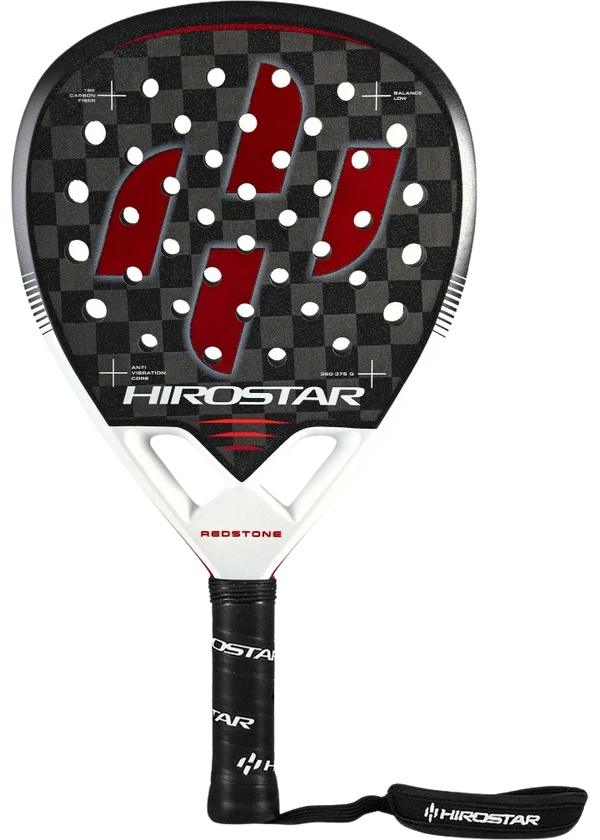
8 Parameters
Redstone 2026
On this page
Review
Hirostar Redstone 2026 Review — Diamond Shape, Hybrid Soul
Diamond rackets carry a reputation: power-first, comfort-second, and firmly planted on the left side of the court. The Hirostar Redstone 2026 challenges that stereotype directly — built as a diamond that plays more like a hybrid, it targets intermediate players who want offensive shape without sacrificing the maneuverability to play the right side effectively. The tension it resolves is real: you get the high balance point geometry without paying for it in feel or handling speed.
The Redstone runs a Black EVA 17 foam core inside a full carbon frame, with dual-layer 18K carbon faces finished with a sandblasted texture for grip and spin generation. Profile thickness sits at 38mm. The proprietary Anti-Vibration Convex Bridge reduces vibration transmission through the frame — Hirostar positions it as a stability and arm-protection feature combined. Balance lands at 260mm, keeping the racket feeling lower in hand than the diamond geometry alone would suggest. Declared weight is 367g, confirmed by independent on-camera measurement.
Maneuverability leads at 8.2 — the highest single parameter in this profile. Attacker: 7.82 / Hybrid: 7.89 / Defender: 7.88. The profile gap of just 0.07 across all three roles is the real story: this racket refuses to specialize, and that versatility is either the point or the problem depending on what you need.
Performance Breakdown
How the Hirostar Redstone 2026 Plays
SPIN 7.9
Offensive Output That Earns Its Shape
The dual-layer 18K carbon face structure and sandblasted finish do measurable work here. Power comes in at 7.8 — solid for a diamond racket at this balance point, though not peak-aggressive territory. Spin at 7.9 is the slightly stronger figure, and field data backs it: the sandblasted texture generates consistent grip on the ball without requiring technical precision to activate. Together these two scores confirm the Redstone earns its diamond classification offensively, even if it doesn’t overwhelm in either direction.
PLAYABILITY 7.8
The Counterintuitive Number in This Profile
Maneuverability at 8.2 is the single highest score in this racket’s profile — and it’s the most unexpected result for a diamond shape. The 260mm balance point does the work: keeping weight centred in hand means transitions stay fast even under pressure, which is precisely why right-side players find this racket viable despite its geometry. Playability at 7.8 echoes that — field impressions consistently describe the diamond racket handling as surprisingly approachable for an intermediate level, with technical demand described as moderate rather than high.
COMFORT 7.6
The Bridge Does Real Work
Control at 8.1 sits above what the diamond shape typically allows, and that’s partly structural — the EVA 17 core softens response at contact in a way that harder cores on comparably spec’d frames don’t. The Anti-Vibration Convex Bridge contributes to Comfort’s 7.6, reducing arm transmission without turning the feel muted; reviewers specifically describe the touch as alive rather than deadened. For a full-carbon construction this is a meaningful distinction: the Redstone doesn’t trade feel for protection, it manages to hold both.
STABILITY 7.5
Where the Diamond Tax Shows Up
Sweetspot Size at 7.4 is the lowest score in the profile, and it tells a familiar story about diamond geometry: the concentrated sweet zone rewards clean contact and punishes mishits more than a round or drop shape would. Stability at 7.5 is respectable given the weight distribution, though the Anti-Vibration Bridge contributes more to comfort than to torsional resistance on off-centre strikes. These two scores together define the ceiling for less experienced players — the Redstone asks for a reasonably consistent technique to deliver what its offensive parameters promise.
Technology
Anti-Vibration Convex Bridge: Structural Compromise or Genuine Advantage?
The Anti-Vibration Convex Bridge is Hirostar’s frame-integrated vibration management system — a specific bridge geometry built into the carbon frame that interrupts vibration transmission before it reaches the handle. This isn’t a grip dampener or add-on accessory; it’s structural, which means it operates on every contact regardless of player technique or swing speed.
The measurable result shows up across two parameters. Comfort at 7.6 is meaningfully above what a stiff all-carbon diamond frame typically produces — the bridge absorbs enough resonance to keep extended play sessions tolerable without requiring the player to compensate with grip pressure. Stability at 7.5 also benefits: the convex geometry adds lateral rigidity to the frame section near the bridge, which partially offsets the torsional vulnerability that comes with a higher balance point and smaller sweetspot.
The technology earns its place most visibly in Control’s 8.1 score. Reducing unwanted vibration means the feel signal that reaches the player’s hand is cleaner — the ball’s response reads more accurately at contact. That matters more for control-oriented players than for pure attackers, which is precisely why the Hirostar Redstone 2026 sits in hybrid territory rather than pushing fully offensive. Players with any arm sensitivity history will find this a relevant feature, not a marketing footnote. Those prioritising raw power above all else may find the Hirostar lineup offers less aggressive options elsewhere.
Player Fit
Who Should Buy the Hirostar Redstone 2026?
The Versatile Intermediate Who Wants Diamond Without Commitment
If you’re the type who gravitates toward diamond shape for its offensive promise but still rotates between left and right side — or needs to — the Redstone was built around your game. The Maneuverability score of 8.2 means you won’t feel penalised in transitions, and Control at 8.1 gives you enough feedback to construct rallies rather than just hit through them. The tight profile spread (Hybrid 7.89, Defender 7.88, Attacker 7.82) tells you this racket doesn’t demand you commit to one role. You bring a reasonably consistent technique, and the Redstone hands back more dimensions than most diamonds at this level will.
The Specialist Attacker Who Needs Maximum Power
If your game is built entirely around left-side attacking volume and you need a racket that maximises power output above every other consideration, the Attacker score of 7.82 — the lowest of the three profiles — tells you what you need to know. The Sweetspot Size at 7.4 adds further cost: consistent power delivery requires cleaner contact than a more forgiving frame would demand. This racket’s hybrid soul is a feature for versatile players and a ceiling for pure attackers. You’d be better served by a dedicated offensive diamond with a harder core and higher balance point.
FAQ
Frequently Asked Questions
What is the PadelVerdict score for the Hirostar Redstone 2026?
The overall PadelVerdict score is 8.0, with a Consensus Modifier of +0.1. Specs are consistent across multiple sources (Data Quality: neutral), independent on-camera measurements across multiple markets confirmed the declared 367g weight with no contradictions found (Field Validation: positive), but no certified lab measurements exist to go further (Market Correction: neutral). Profile breakdown: Hybrid 7.89 / Defender 7.88 / Attacker 7.82. The 0.07 gap between profiles means this racket doesn’t favour a single role — which is itself the decision you need to make.
Is the Hirostar Redstone 2026 good for intermediate players?
Yes, with one condition. The Playability score of 7.8 and Maneuverability of 8.2 make the technical demand moderate rather than steep — field impressions describe it as approachable for the level. The condition is Sweetspot Size at 7.4: if your contact consistency is still developing, mishits will be noticeable. Intermediate players with reasonably solid technique get the full benefit; those still building fundamentals should consider a rounder shape first.
Is the Hirostar Redstone 2026 good for hybrid players?
Yes. The Hybrid profile score of 7.89 leads the three profiles — barely, but it leads. More tellingly, Maneuverability at 8.2 and Control at 8.1 are exactly the two parameters hybrid players depend on to switch roles mid-rally. Spin at 7.9 adds a third weapon. If you play all-court and want a diamond that doesn’t punish that, this is a strong candidate. Browse the hybrid racket category to see how it compares across the field.
What is the actual weight of the Hirostar Redstone 2026?
Declared weight is 367g, and independent on-camera measurements across multiple markets land consistently at 367–367.7g. That’s essentially zero variance — unusually tight for a racket at this price tier. On court, 367g sits at the heavier end of the intermediate range, so players sensitive to arm fatigue should factor that in alongside the Anti-Vibration Bridge’s comfort benefit.
How does the Hirostar Redstone 2026 compare to the Hirostar Blackstone?
The Redstone is the more offensive sibling — dual-layer 18K carbon faces versus the Blackstone’s single layer makes it more reactive and more powerful at contact. The Blackstone suits players who want slightly softer response and less arm demand; the Redstone suits those who want the same brand’s chassis in a higher-output configuration. If you’re choosing between the two, the question is how much you want the offensive step-up and whether your technique can activate it consistently.
Why does the Hirostar Redstone 2026 have a Consensus Modifier of +0.1?
The +0.1 is driven by confirmed physical measurement. Specs appearing consistently across sources establishes the baseline — that alone earns neutral, not positive. What pushes the modifier upward is independent video testers across multiple markets weighing this specific racket on camera and landing at 367–367.7g, in near-perfect alignment with the declared figure. That on-camera confirmation of a physical spec is what separates this modifier from zero. The ceiling stays at +0.1 because no certified lab measurement or balance point confirmation exists to go further.
Similar Rackets
Independent testing, funded by readers
No brand deals, no sponsored picks. If you found this useful, you can support the next round of tests with a small tip.

