
Flame Soft 2026
The Comfortable Choice That Still Means Business
The short verdict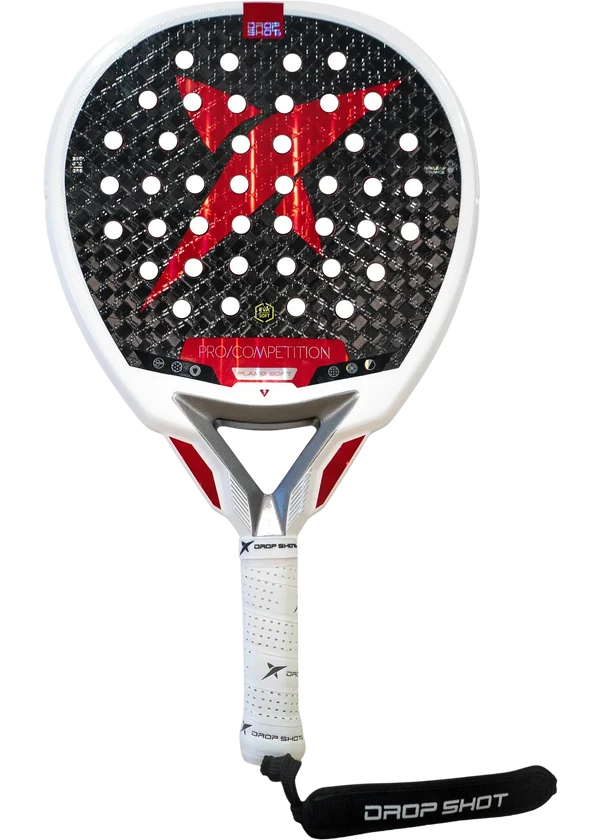

8 Parameters
Flame Soft 2026
On this page
Review
Drop Shot Flame Soft 2026 Review — The Comfortable Choice That Still Means Business
The word “soft” in a padel racket name sets off an alarm for competitive intermediate players: softer usually means slower exit, more forgiveness traded for less pace, a racket that protects your arm by costing you a point. The Drop Shot Flame Soft 2026 is built to argue with that assumption — pairing a low-density EVA core with a 12K carbon surface and a 38mm profile that refuses to give up structural authority.
The Flame Soft sits in Drop Shot’s 2026 lineup as a drop-shaped hybrid — 368g midpoint weight, medium-high balance at 262mm, with two proprietary systems layered on top of the core construction. The 3D Face System applies a three-dimensional texture to the 12K carbon surface to generate spin and improve directional precision at contact. The Smart Holes System rearranges the hole pattern in a curved, progressive distribution designed to expand the sweetspot and stabilize off-center strikes. Twin tubular carbon frame construction handles rigidity and long-term durability. Declared weight range is 360–375g; no independent measurements have been taken on this model.
Comfort leads at 8.3 — the single highest parameter score. Attacker 7.52 / Hybrid 7.93 / Defender 7.93. The 0.41 gap between Attacker and the top two profiles is the clearest signal this racket sends: it is built for players who want everything except pure aggression.
Performance Breakdown
How the Drop Shot Flame Soft 2026 Plays
PLAYABILITY 8.1
The Arm Never Lies
EVA Soft Low Density foam is the engineering decision that defines this racket before anything else does. It absorbs impact across the entire hitting surface, not just at dead-center contact, which means long sessions produce notably less cumulative fatigue than a harder-cored alternative at the same weight class. At 8.3, Comfort is the top-scoring parameter in the entire profile — not a marketing priority, but a structural reality confirmed by the core choice. Playability at 8.1 reflects how that comfort translates into confidence: the racket doesn’t demand perfect swing mechanics to produce usable output, which is precisely what intermediate players need to sustain quality across a full match.
SWEETSPOT 7.9
Direction Before Destination
The drop shape concentrates mass toward the handle end, and at a 262mm balance point it keeps the pickup feel neutral — not sluggish, not tip-heavy. Control at 8.1 reflects a racket that communicates well at contact: the soft core slows the dwell time just enough for the player to feel directional input without needing to fight the frame. Sweetspot at 7.9 is where the Smart Holes System earns its place — the progressive hole distribution expands the forgiving zone meaningfully, so off-center strikes don’t punish with deflection.
SPIN 7.2
Quick Enough, But Not a Weapon
At 368g midpoint with a handle-favorable balance, maneuverability lands at a solid 7.8 — fast enough for net exchanges and reactive defense without demanding elite swing speed. The drop shape supports this: compared to a diamond of equivalent weight, it moves more naturally through reactive shot situations. Spin at 7.2 is the weakest parameter, and it is worth understanding why: the 3D Face System texture does add grip on the ball, but the soft core’s slower exit speed limits the window for generating heavy rotation. Players who want to live on topspin drives and aggressive kick serves will find the Flame Soft less equipped than harder-cored alternatives in the same lineup.
STABILITY 7.3
The Trade-Off Is Real
Power at 7.4 and Stability at 7.3 are the lowest scores in the profile, and they tell a coherent story. The EVA Soft core, by design, absorbs energy — that is what makes it comfortable. But energy absorption and power transfer are opposites, and the result is a racket that will not overwhelm opponents from the back of the court with raw pace. Stability at 7.3 reflects the frame’s behavior under hard, off-axis impact: the twin tubular construction provides meaningful rigidity, but against a pace-heavy incoming ball, the soft core introduces a slight lack of solidity that players at higher competitive levels will notice. Below that threshold, it is a non-issue.
Technology
3D Face System + Smart Holes: Two Systems, One Clear Purpose
The 3D Face System applies a three-dimensional micro-texture across the 12K carbon surface. In practical terms, this creates more friction between ball and faces at contact, which extends the grip window and lets players add intentional rotation without requiring a heavy swing. It directly supports the Spin score of 7.2 — not a high number, but meaningfully higher than a flat carbon surface of equivalent stiffness would produce. It also improves directional consistency on slice and angled volleys, which feeds into the Control score of 8.1. Among drop-shaped rackets in this category, textured carbon surfaces are increasingly common, but the 3D Face System integrates unusually well with the softer core because ball contact is already longer — the texture has more time to work.
The Smart Holes System is less visible but arguably more impactful for the target player. By distributing holes in a curved, progressive pattern rather than a conventional grid, it increases frame flexibility at the edges of the face. This softens off-center impact and reduces the angle of deflection on mishits — the mechanism behind the Sweetspot score of 7.9. For an intermediate player who is still developing placement consistency, this is not a gimmick; it is the difference between a point lost to a mishit and one that stays in play.
Together, the two systems work in the same direction as the EVA Soft core: they expand the margin for error without eliminating the reward for precision. That coherence is what makes the Drop Shot Flame Soft 2026 a well-engineered racket rather than a compromise — every element is pointing at the same player type.
Player Fit
Who Should Buy the Drop Shot Flame Soft 2026?
The Intermediate Who Plays Long and Thinks First
If you’re the type who plays two or three sessions a week and finds your arm tightening up by the third set, this racket addresses that directly — Comfort at 8.3 isn’t marketing language, it’s the EVA Soft core working as designed. If you build points through placement rather than pace and want a racket that rewards patient, directional play, Control at 8.1 and Playability at 8.1 both validate that approach. The Hybrid and Defender scores are identical at 7.93, which means the racket doesn’t force a role on you — it works from the net and from the back with equal competence. If you’ve been wondering whether you need to choose between comfort and performance, the Flame Soft is the answer that says you don’t.
The Power-First Attacker Who Wants to Dominate
If your game is built around smashing winners from the net and generating heavy topspin from the baseline, the Attacker score of 7.52 tells you everything. Power at 7.4 and Spin at 7.2 — the two lowest parameters in the profile — are precisely the tools an aggressive player needs most. The soft core absorbs the energy you’re trying to transfer; the 3D Face System adds some spin, but not enough to compensate for the exit speed deficit. This is not a racket that will amplify your aggression. The Axion Attack 2.0 2026 is built specifically for that role.
FAQ
Frequently Asked Questions
What is the PadelVerdict score for the Drop Shot Flame Soft 2026?
The overall PadelVerdict score is 8, with a Consensus Modifier of 0. Specs are consistent across multiple sources (Data Quality: neutral), declared figures show no implausible outliers (Field Validation: neutral), but no independent measurements exist to confirm them (Market Correction: neutral). Profile breakdown: Attacker 7.52 / Hybrid 7.93 / Defender 7.93. The tied Hybrid and Defender scores — with Attacker 0.41 behind — confirm this is a versatile racket that firmly rejects a power-first identity.
Is the Drop Shot Flame Soft 2026 good for intermediate players?
Yes, directly and specifically. Playability at 8.1 is the key parameter here — it reflects how readily the racket produces usable output without demanding elite technique. Combined with Comfort at 8.3, it’s engineered for players who are still building consistency. If you’re at an advanced level and generating serious pace already, you’ll want a racket with a harder core that transfers more energy rather than absorbing it.
Is the Drop Shot Flame Soft 2026 good for hybrid players?
Yes. The Hybrid score of 7.93 is the joint-highest in the profile, and it’s earned by a racket that genuinely functions across court positions. Control at 8.1, Sweetspot at 7.9, and Maneuverability at 7.8 all support the all-court game without forcing a specialist role. If you want to explore more options in this category, the hybrid racket category is worth browsing.
What is the actual weight of the Drop Shot Flame Soft 2026?
The declared range is 360–375g, with no independent measurements available for this exact model. The 368g midpoint is used in scoring. That 15g spread is meaningful — a unit at the top of the range will feel noticeably different from one at the bottom, particularly in extended exchanges. If weight precision matters for your game, handle the racket before committing.
How does the Drop Shot Flame Soft 2026 compare to harder-cored models in the same lineup?
This is a choice between two player types, not two spec sheets. The Flame Soft gives you arm protection, a longer dwell time, and broader forgiveness — at the cost of exit speed and spin generation. The harder-cored alternatives reverse that equation: more pace, more spin potential, less margin for error. If you’re unsure which side of that line you’re on, play a full session with each and let the third set tell you.
Why does the Drop Shot Flame Soft 2026 have a Consensus Modifier of 0?
Because the data holds together and stops there. Specs for this model appear uniformly across multiple markets — shape, core, surface, balance, and weight range all align without contradiction. That coherence establishes the baseline. It doesn’t go beyond it. Neutral is the accurate read of what the evidence confirms, and 0 is where it lands.
Similar Rackets
Independent testing, funded by readers
No brand deals, no sponsored picks. If you found this useful, you can support the next round of tests with a small tip.

