
Counter Viper 2026
The Back-Court Weapon That Actually Lets You Attack
The short verdict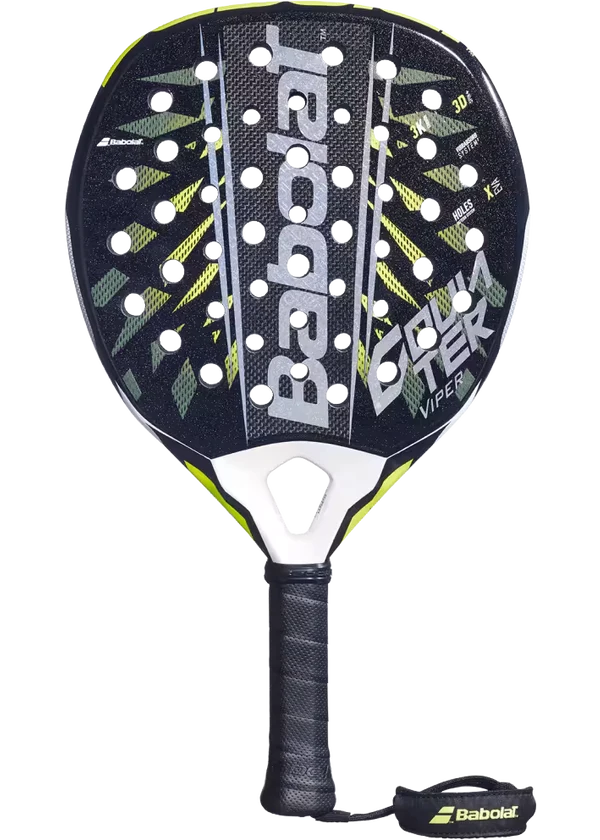


8 Parameters
Counter Viper 2026
On this page
Review
Babolat Counter Viper 2026 Review: The Back-Court Weapon That Actually Lets You Attack
The hardest thing to engineer in a defender’s racket is permission to go on the offensive. Build too much forgiveness and you sacrifice the zip that turns a blocked ball into a winner. Build too much power and the comfort disappears along with the consistency. The Babolat Counter Viper 2026 is designed around exactly that tension — a counter-attacking tool that wants to reward patience first and aggression second.
The specs tell a deliberate story. A round-shaped frame with a 268mm balance point sits on the heavier end of the intermediate range at a measured 368g. The core is X-EVA multi-density foam in a sandwich construction — rigid outer layers for reactivity, softer middle for absorption — wrapped in 3K carbon with a rough 3D Spin+ surface finish. Babolat’s Vibrabsorb System² handles vibration damping through SMAC elastomers placed in both the core and handle, while the Holes Pattern System optimises hole distribution for shot precision and spin transfer. Part of Babolat’s 2026 Technical Collection, it sits as the control-focused option alongside the power-oriented Viper and Air Viper siblings.
Control leads at 8.7 — the highest single parameter score in this racket’s profile. Defender: 8.28 · Hybrid: 8.07 · Attacker: 7.95. The gap between profiles is narrow (0.21 between Defender and Attacker), which means this racket suits patient counter-punchers but won’t punish all-court players who stray from their baseline.
Performance Breakdown
How the Counter Viper 2026 Plays
SWEETSPOT 8.3
Where the Whole Racket’s Case Gets Made
The round shape combined with X-EVA’s soft inner layer creates a dwell time that gives you genuine directional control — balls don’t just rebound, they respond. That’s backed by an 8.7 Control score, the standout figure across the entire profile. The sweetspot size at 8.3 means off-centre contact stays purposeful rather than punishing, which is exactly what a counter-attacker needs when forced wide. Together, these two parameters make the Counter Viper 2026 a racket you can trust to place the ball when under pressure, not just return it.
PLAYABILITY 8.1
The 3D Surface Earns Its Place
Spin and playability both land at 8.1 — not a coincidence. The 3K carbon rough finish with raised 3D Spin+ texture generates meaningful bite on lifted and sliced balls, which is how a defender turns a reset into a threat. The playability score reflects how readily the racket adapts across shot types, from a defensive lob to a counter-attack drive, without demanding technique adjustments between rallies. For round-shaped rackets, a spin score this high is genuinely notable — most round frames prioritise feel over grip.
STABILITY 7.8
Long Sessions Without the Penalty
Comfort at 7.9 is a direct result of the Vibrabsorb System² doing measurable work — the combination of SMAC elastomers in both the core and handle addresses vibration at the source rather than masking it with a thick grip. Stability lands at 7.8, which is appropriate for a round frame at 368g: it handles pace without twisting but won’t absorb a hard-driven ball from a close-range attacker as cleanly as a heavier, more head-heavy option would. Build quality is consistent with what this price point demands — no structural concerns have emerged at this stage.
MANEUVERABILITY 7.4
The Trade-Off That Defines the Racket
Power at 7.8 is respectable for a control-oriented round frame — the 3K carbon surface delivers reactive pop that rewards counter-attacks rather than generating raw force. Maneuverability at 7.4 is the lowest score in the set and deserves honest attention: at 368g with a 268mm balance point, the Counter Viper 2026 is on the heavier side for a round racket, and players who rely on fast-arm net exchanges will feel that weight in extended rallies. This is the score that tilts the profile toward Defender and away from Attacker — and the primary reason the attacker profile gap exists.
Technology
Vibrabsorb + 3D Spin+: Engineering Comfort and Aggression Into the Same Frame
The Vibrabsorb System² places SMAC elastomers at two points in the racket — inside the core sandwich and within the handle itself. This isn’t a single dampener managing vibration after the fact; it’s a dual-stage system that addresses shock at the moment of contact and again at the point of transfer to the hand. The practical result is the 7.9 Comfort score: noticeably above what a stiff 3K carbon frame would produce on its own, and meaningful enough for players managing arm sensitivity over long sessions.
The 3D Spin+ surface texture operates on the same principle of doing something structural rather than cosmetic. The raised relief pattern on the 3K carbon surface increases contact friction on glancing shots — that’s the mechanism behind the 8.1 Spin score, and it’s what gives slices and lifted balls genuine trajectory variation. Defenders who use spin as a tactical tool rather than a finishing move will feel the difference.
The Holes Pattern System optimises the hole distribution across the face to balance precision and spin transfer — a less visible technology, but one that contributes directly to why sweetspot size sits at 8.3 despite the frame’s relatively stiff carbon construction. The Smart Buttcap, offering a customisable wrist strap, is a minor ergonomic addition with no impact on performance scores. The technologies that matter most here are the ones that explain why this racket feels different from a standard carbon round frame at the same weight — and they do explain it.
The player who benefits most is a back-court intermediate to advanced who needs comfort during long defensive exchanges and wants spin variety without sacrificing the control precision that makes counter-attacks land where intended. The Vibrabsorb system makes fatigue-driven errors less likely. The 3D Spin+ makes patterns more varied. Neither technology is marketing language — both have measurable outputs in the scores above.
Player Fit
Who Should Buy the Counter Viper 2026?
The Tactical Back-Court Intermediate Who Wants to Hurt You From the Baseline
If you’re the type who builds points patiently from the back, resets under pressure without panic, and looks for the moment to accelerate rather than forcing it — this racket is built around your game. The 8.7 Control score means placement is reliable even when you’re stretched. The 8.3 sweetspot size and 8.1 spin give you the tools to make defensive returns actively difficult to attack. The Vibrabsorb system supports the long sessions your game demands. You play three-hour doubles and your arm feels it — with the Counter Viper 2026, that changes.
Net-Hunters and Power Players Who Need Arm Speed at the Volley
If your game is built around fast net exchanges, smashes, and aggressive net approaches, the 7.4 Maneuverability score will cost you. At 368g, this is not a racket that rewards quick arm movements at the net — it rewards deliberate, well-timed strokes from depth. The Attacker score of 7.95, the lowest of the three profiles, tells that story cleanly. Power players who want a round frame for comfort but need more explosiveness should look at the Babolat Air Viper 2.6 2026 — lighter, faster, built for exactly that combination.
FAQ
Frequently Asked Questions
What is the PadelVerdict score for the Babolat Counter Viper 2026?
The overall PadelVerdict score is 8.5, with a Consensus Modifier of +0.1. Specialist descriptions across multiple markets align closely on the counter-attacking, control-defensive profile — and an on-camera weight measurement confirmed 368g, closely matching the declared spec. That combination of cross-market consistency and physical validation earns the positive adjustment. Profile breakdown: Defender 8.28 · Hybrid 8.07 · Attacker 7.95. The narrow gap between profiles means this isn’t a single-role specialist — but the Defender edge is real.
Is the Babolat Counter Viper 2026 good for intermediate players?
Yes, with one condition: you need to already be comfortable reading the back court and building points deliberately. The 8.3 sweetspot and 8.7 control make it forgiving enough to develop consistency, but the 7.4 Maneuverability means beginners or players who rely on reactive, instinctive arm movement will struggle. If you’re an intermediate who plays positioned and patient, this is a strong fit. If you’re still developing court sense, a lighter round frame with a higher maneuverability score would serve you better right now.
Is the Babolat Counter Viper 2026 good for defensive players?
Yes — it’s the standout profile. The Defender score of 8.28 is the highest of the three, backed by 8.7 Control, 8.3 Sweetspot, and 8.1 Spin. Those aren’t just comfortable numbers; they’re the specific combination that lets defensive players reset reliably and then spin their way back into the rally offensively. If you’re shopping specifically in this category, check the full defender racket category to compare options at the same level.
What is the actual weight of the Babolat Counter Viper 2026?
Babolat declares 365g ±10g. One on-camera measurement returned 368g — a 3g difference, which is within tolerance and imperceptible on court. The declared spec is honest for this model. What matters more is that 368g sits on the heavier end for a round frame, and that is perceptible during fast exchanges. Buy knowing you’re holding a substantial racket, not a light one.
How does the Babolat Counter Viper 2026 compare to the Babolat Viper 2026?
Think of it as a choice between two games, not two specs. The Viper is positioned as the power option — diamond-leaning, more aggressive, less forgiving. The Counter Viper is the control option: round, patient, suited to players who build from the back and redirect pace rather than generate it. If your instinct is to accelerate the ball, the Viper. If your instinct is to absorb it and place it, the Counter Viper. The names alone tell the story — one chases power, the other converts it.
Why does the Babolat Counter Viper 2026 have a Consensus Modifier of +0.1?
Two things drive it. First, specialist descriptions across multiple markets converge on the same counter-attacking, control-defensive profile with no conflicting signals — that cross-market coherence is a meaningful data quality signal. Second, a physical weight measurement confirmed 368g against the declared 365g, the closest independent validation available for this model. Together those earn a +0.1. A confirmed balance point measurement would be required to push the modifier further.
Similar Rackets
Independent testing, funded by readers
No brand deals, no sponsored picks. If you found this useful, you can support the next round of tests with a small tip.

