
Electra Pro 2026
Does This Drop Shape Hybrid Actually Deliver Both Ways?
The short verdict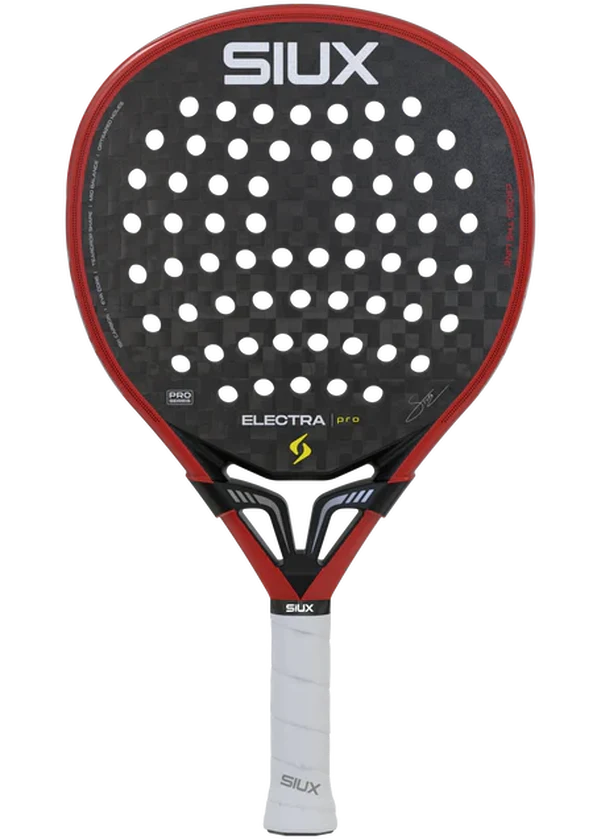

8 Parameters
Electra Pro 2026
On this page
Review
Siux Electra Pro 2026 Review — Does This Drop Shape Hybrid Actually Deliver Both Ways?
The central tension in mid-high padel rackets is almost always the same: optimise for power and you sacrifice feel; lean into control and the racket becomes passive at the net. Hybrid drop-shape rackets promise a third path — but most end up stranded in the middle, neither truly threatening from the back nor precise enough under pressure. The Siux Electra Pro 2026 positions itself as a resolution to that problem, not a compromise of it. Franco Stupaczuk’s signature racket, built for competition-level all-court play, is the claim. The scores are what tell us whether the claim holds.
Technically, the Electra Pro 2026 runs a hard-density EVA core inside a double tubular carbon frame at 38mm profile and 72 RA stiffness. The surface is 12K carbon with a sand finish. Siux integrates the LIGHTNING frame-stiffening system for explosive response, two Shockout antivibrators at the base of the face for vibration management, and the Switch Strap replaceable safety cord. Declared weight range is 355–375g with 362g as the most cited field figure. The balance sits at medium-high. For context on where this sits in the brand’s lineup, see all Siux padel rackets.
The most telling number here isn’t Power (8.2) — it’s Control (8.4), which outscores it. On a racket with a hard EVA core and a 12K carbon face, that inversion is the story. Profile breakdown: Attacker 8.01 · Hybrid 8.05 · Defender 7.80. The gap between Attacker and Hybrid is just 0.04 points — functionally identical. The Electra Pro 2026 is genuinely suited to multiple playing styles, and the Defender gap of 0.25 from the top score is the only real boundary the numbers draw.
Performance Breakdown
How the Siux Electra Pro 2026 Plays
CONTROL 8.4
Control Wins, and That Changes Everything
Hard EVA cores don’t typically produce high control scores — they produce exit velocity. The sand-finish 12K carbon surface slows the ball off the face just enough to extend the contact window, and the drop shape places that contact zone in a position that benefits precision shots: volleys, chiquitas, cross-court drives. Control lands at 8.4, fractionally above Power at 8.2, and that’s a meaningful inversion. It means the racket rewards technical players more than it rewards those who just swing harder.
Power at 8.2 is very good — fast ball exit on smashes is consistently noted, and the LIGHTNING frame system contributes a measurable stiffness advantage when striking at full pace. But the Electra Pro 2026 isn’t a wrecking ball. It’s a racket that gives advanced players the option to be explosive or precise, depending on the situation. That duality is exactly what the Hybrid score of 8.05 is measuring.
MANEUVERABILITY 7.6
Spin Is Honest; Maneuverability Needs Realistic Expectations
The sand finish texture on 12K carbon is one of the more effective surface treatments for generating heavy ball rotation — abrasive enough to grip the ball on contact without over-damping the shot. Spin at 7.8 reflects genuine capability on viboras and bandejas, not a marketing-label texture. The friction is real and functional for the advanced player looking to generate topspin from the back or add angle on net attacks.
Maneuverability at 7.6 is the number to calibrate expectations around. At 362g with a medium-high balance, this isn’t a quick-armed weapon for reflexive exchanges at the net. It moves well for its weight class, but players used to lighter round-shape rackets will feel the difference. This score is a profile signal, not a flaw: the Electra Pro plays best with deliberate, well-timed swings. See our drop-shape racket guide for comparable options in this geometry.
STABILITY 8.0
PLAYABILITY 7.4
Stability Is the Frame’s Real Argument
Stability at 8.0 is the structural story of the Electra Pro 2026. The double tubular carbon frame combined with 72 RA stiffness produces a racket that holds its angle under hard contact — off-pace returns, cross-court drives, and blocked volleys all stay on trajectory rather than twisting on the arm. This is where the 12K carbon layup earns its price tag: the racket doesn’t flex under pressure, it transfers energy cleanly and consistently.
Sweetspot at 7.4 and Playability at 7.4 are honest assessments of a hard-core racket aimed at skilled players. The LIGHTNING system and drop geometry do widen the effective zone relative to a pure attacking diamond, but this is not a forgiving racket for inconsistent technique. These scores explain the Defender profile of 7.80 — the racket requires the player to do the work. No durability concerns have been reported at this stage. This section updates as long-term data becomes available — typically 60+ days post-launch.
The Shockout System Does Work — But It Has a Ceiling
Comfort at 7.0 is the lowest score on the card, and on a racket running at 72 RA with a hard EVA core, that’s expected and honest. The two integrated Shockout antivibrators at the base of the face do attenuate vibration in a measurable way — dual placement targets the frequency range most associated with elbow fatigue, and the Shockout overgrip adds a further layer of damping at the handle. The system works.
But 7.0 reflects the ceiling of what damping technology can do when the underlying material is this stiff. Players with existing arm sensitivities should treat this racket with caution, especially at high session volumes. For the target player — advanced, technically clean, competitive frequency — the comfort level is appropriate and sustainable.
Technology
LIGHTNING + Shockout: Does Pairing Speed With Damping Actually Make Sense?
The LIGHTNING system is Siux’s frame-stiffening architecture — it increases structural rigidity in the carbon layup to minimise flex during high-velocity contact. Energy loss at the frame wall is reduced, and ball exit speed is higher and more predictable. The effect shows up directly in Stability (8.0) and Power (8.2): both scores reflect a frame that doesn’t absorb energy it should be returning. For a player hitting smashes or aggressive volleys at full extension, that stiffness is an advantage. The ball leaves where you point it.
The Shockout antivibrator placement — two units at the lower face plus the overgrip — is a deliberate countermeasure to the high-frequency vibration that LIGHTNING’s stiffness generates. The logic is not contradictory: you want the racket rigid enough to perform, but you want the vibration dampened before it reaches the arm. The dual face placement targets the lowest nodes of the frame where resonance is highest. This is why Comfort lands at 7.0 rather than 6.5 — the mitigation is real, even if the baseline stiffness means 7.0 is the realistic ceiling.
The sand-finish 12K carbon surface contributes to Spin (7.8) by increasing ball-surface friction on brushed contact without meaningfully reducing ball pace on flat shots. Medium-rough: aggressive enough for heavy rotation, not so coarse that it costs Control.
Who benefits: the advanced all-court player who values structural predictability under competition intensity. The LIGHTNING + Shockout combination is particularly well-suited to high-frequency players — those who train and compete multiple times per week — because the damping system actively manages the cumulative vibration load that a stiff frame would otherwise deliver.
Player Fit
Who Should Buy the Siux Electra Pro 2026?
The Advanced All-Court Player Who Hates Choosing
If you’re the type who splits time between dictating from the net and constructing points from the back, this racket doesn’t force a compromise. The Attacker (8.01) and Hybrid (8.05) scores are separated by four hundredths of a point — effectively the same racket for both roles. Control at 8.4 gives you precision on chiquitas and cross-court passes; Stability at 8.0 means your smashes stay on trajectory under pressure. Power at 8.2 closes out points when the opportunity arrives.
You need clean mechanics and consistent contact — the Sweetspot score of 7.4 is honest about that. But if you’re at intermediate-advanced or above, technically reliable, and competing regularly, the Siux Electra Pro 2026 is built exactly for your game. You already know when you hit it right. This racket makes that feeling happen more often. For context beyond this review, see where it lands among our independently scored top rackets of 2026.
Developing Players, Defenders, and Anyone With Arm Issues
The Defender score of 7.80 is the data telling you something. This racket does not reward scramble play, late reactions, or off-centre contact. Maneuverability at 7.6 and Sweetspot at 7.4 are the parameters that punish inconsistency — and if your game involves more retrieving than attacking, you will feel those numbers every session.
If you’re still building technique, or if arm comfort is non-negotiable, the 72 RA stiffness and hard EVA core will work against you. The Shockout system helps, but Comfort at 7.0 is the ceiling. The sharper line: this is a racket that expects you to have already earned it.
FAQ
Frequently Asked Questions
What is the PadelVerdict score for the Siux Electra Pro 2026?
The Siux Electra Pro 2026 scores 8.2 overall. Consensus Modifier: 0 — sources align on specs but no independent lab measurements are available to adjust the score. Profile scores: Attacker 8.01, Hybrid 8.05, Defender 7.80. The 0.04 gap between Attacker and Hybrid means the racket genuinely serves both roles. The only meaningful boundary is toward pure defending, where Maneuverability and Sweetspot start to matter.
Is the Siux Electra Pro 2026 good for advanced players?
Yes — this is where it belongs. Sweetspot at 7.4 and Playability at 7.4 define the skill floor: they reward clean contact and punish imprecision. Recreational players or those still developing technique will find it demanding. Look at the Siux Electra Elite 2026 instead — softer core, more forgiving geometry, same brand architecture.
Is the Siux Electra Pro 2026 good for hybrid and all-court players?
Yes, and it’s probably the best argument for buying it. Hybrid score 8.05 is the highest of the three profiles. Control at 8.4 supports precision in the transition zone; Stability at 8.0 holds shots on line from mid-court; Power at 8.2 closes points at the net. If your game is to control the point and finish it, this racket confirms your instinct. See our best hybrid padel rackets guide for the full category.
What is the actual weight of the Siux Electra Pro 2026?
Declared range is 355–375g; 362g is the most consistently cited field figure across commercial sources. No independent tester-weighed values published at this stage. At 362g, this sits mid-to-heavy for its category — perceptible in extended rallies and transition play, not unusual for a competition-grade hard EVA drop-shape racket.
How does the Siux Electra Pro 2026 compare to the Siux Electra Elite 2026?
A choice between two player types. The Pro is built for advanced players confident in their contact quality — harder core, stiffer frame, higher Power and Stability, lower Comfort ceiling. The Elite uses a softer mid-hard core: more forgiving off-centre, easier on the arm across a week of training, slightly lower ceiling on explosiveness. If you’re asking yourself “can I handle the Pro?”, that question is its own answer.
Why does the Siux Electra Pro 2026 have a Consensus Modifier of 0?
Sources across multiple markets agree on the technical character — hard EVA, 12K carbon, drop shape, mid-high balance, all-court profile — with no conflicting signals. However, no independent lab measurements or community feedback from real-world players have been published. Without field validation we cannot apply a positive adjustment. The base score of 7.9 stands on the data we have.
Similar Rackets
Independent testing, funded by readers
No brand deals, no sponsored picks. If you found this useful, you can support the next round of tests with a small tip.

