R-Ace 2026
Does This Diamond Still Cut?
The short verdict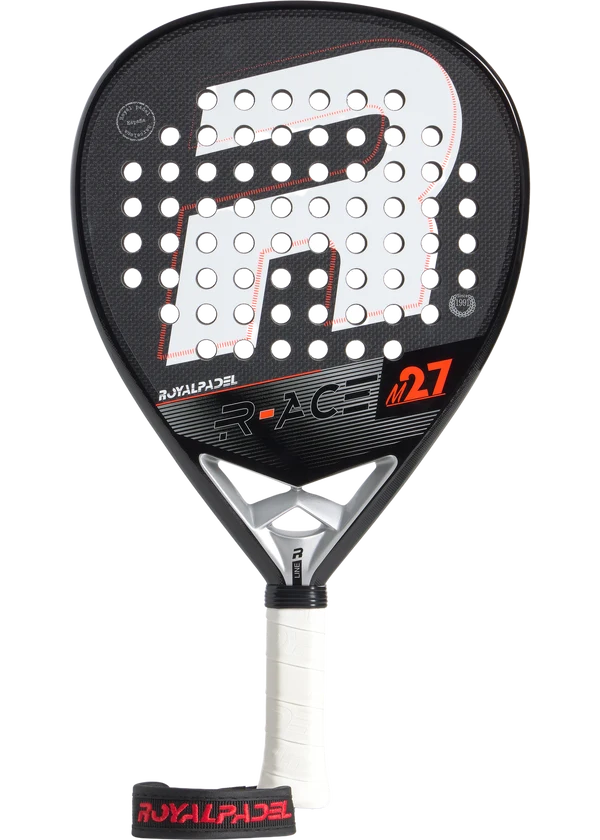

8 Parameters
R-Ace 2026
Review
Royal Padel R-Ace 2026 Review: Does This Diamond Still Cut?
At the premium end of the diamond-shape market, the argument is almost always the same: you trade forgiveness for firepower. Accepting a narrower sweetspot and a higher balance point in exchange for the kind of smash that ends rallies. The Royal Padel R-Ace 2026 is built around precisely that trade-off — a committed power weapon for advanced attackers who have already made peace with the risk, and who need a racket that delivers the upside reliably.
Spec-wise, the R-Ace 2026 is constructed around a mid-density EVA foam core, a 3K carbon frame, and a rough sandpaper-finish surface designed to generate topspin and varied trajectories. Balance sits at a high 270mm, the stiffness rating lands at 62, and the declared weight is 365g. Part of Royal Padel’s advanced lineup, it sits alongside the R-Ace Light 2026 for players who want the same profile in a more manageable package.
Stability at 8.0 is the single strongest number here. Attacker: 7.96 — Hybrid: 7.56 — Defender: 7.28. That 0.68-point gap between Attacker and Defender is the whole story: this racket has a lane, and it’s not wide.
Performance Breakdown
How the Royal Padel R-Ace 2026 Plays
STABILITY 8.0
The Diamond Pays Its Dividend
High balance and a stiff 3K carbon frame are a classic formula for overhead production, and the R-Ace delivers as expected. Power at 8.2 reflects genuine ball acceleration on smashes and aggressive volleys, not just nominal numbers. Stability at 8.0 is the highest score in the profile — the reinforced carbon structure holds its line under hard contact, which prevents energy leaking on off-centre strikes at pace. For a diamond-shaped racket at this level, consistent stability under power is the expected baseline, and the R-Ace meets it.
CONTROL 7.4
Rough Surface Does Real Work
The 3K carbon rough finish is not decorative. A spin score of 7.8 is the second-highest figure in the profile, and it reflects what that sandpaper texture generates on topspin groundstrokes, sliced bandejas, and varied lob trajectories. Control at 7.4 lands in credible territory for a high-balance diamond — notably, it does not collapse under the power spec, which is a more common failure mode than manufacturers acknowledge. The mid-density EVA core moderates feedback rather than filtering it out entirely, giving players enough feel to place the ball deliberately rather than simply launching.
PLAYABILITY 7.1
Adequate Armour for Extended Play
Comfort at 7.2 is not alarming for a stiff, high-balance diamond — the mid-density EVA absorbs vibration sufficiently to keep arm fatigue manageable across a full match. Playability at 7.1 is the more revealing number: it signals that the R-Ace requires competent technique to extract consistent performance. Players who come to the ball poorly, or who are still building their overhead mechanics, will find the margin for error tighter than the power score implies. This is not a racket that forgives imprecision on defence or under fatigue.
SWEETSPOT SIZE 7.0
The Floor That Defines the Profile
Maneuverability and sweetspot size both sit at 7.0 — the lowest scores in the set, and the numbers that explain the entire Defender score of 7.28. A 270mm balance point makes rapid wrist repositioning from deep defensive positions genuinely harder, and a compact sweetspot means mishits on low, wide balls carry real consequences. Neither score is a dealbreaker for the racket’s intended user, but both are structural ceilings: the R-Ace 2026 is not a diamond racket that plays smaller than its shape.
Technology
3K Carbon Rough Construction: Does Material Choice Actually Drive Performance?
The R-Ace 2026 is built on a material stack rather than a single branded system: 3K carbon throughout the frame, a mid-density EVA foam core, and a rough sandpaper-finish blade surface. Each element has a specific on-court function, and none of them is redundant.
The 3K carbon frame provides the structural stiffness — rated at 62 — that drives both the Power score of 8.2 and the Stability score of 8.0. At this weave density, the material resists deformation under hard contact, which means energy from aggressive overhead swings transfers to the ball rather than being absorbed by frame flex. The reinforced construction is the reason the Stability number stays above 8.0 even when the racket is pushed hard on smashes and flat volleys.
The mid-density EVA core operates as the counterbalance to that frame stiffness. At RA 62, a softer core would produce a dead, unpredictable response; a harder one would make arm fatigue a genuine concern. Mid-density EVA at this stiffness sits at a reasonable equilibrium — Comfort at 7.2 and Control at 7.4 are the output of that pairing. The core does not produce exceptional touch, but it prevents the racket from feeling punishing over a full session.
The rough 3K carbon surface is where the spin score of 7.8 originates. The sandpaper texture increases friction between ball and surface on contact, generating more topspin on groundstrokes and more bite on cut shots and bandejas. For an attacker who uses varied trajectories to create angles — not just flat pace — that surface texture is a material tactical advantage. This combination of materials is most coherent for the advanced offensive player who already generates reliable swing speed: the system rewards precision rather than compensating for its absence.
Player Fit
Who Should Buy the Royal Padel R-Ace 2026?
The Advanced Attacker Who Closes From Above
If you’re the type who wins points with overheads rather than surviving them — who naturally plays at net, generates reliable swing speed on smashes, and wants spin variety as a complement to flat power — the R-Ace 2026 is built around your game. Power at 8.2, Stability at 8.0, and Spin at 7.8 cover the three things an offensive net player needs most: acceleration, structural integrity under hard contact, and surface grip for directional variety. The Attacker score of 7.96 is not a surprise given those numbers. What confirms the fit is that Control at 7.4 stays honest — this isn’t a racket that sacrifices placement for brute force. If you play your best padel from inside the service line and want a racket that holds shape under maximum effort, this is the right tool.
Defenders and Players Still Building Their Overhead
If your padel is built around retrieval, lob construction, and counter-punching from the baseline, the 7.0 Maneuverability and 7.0 Sweetspot Size will work against you every time you’re under pressure. The Defender score of 7.28 — 0.68 points below the Attacker — is not a minor gap. A 270mm balance point actively resists the rapid wrist movement defensive play demands, and a compact sweetspot punishes mishits on wide, low balls where defenders live. Similarly, if you’re still developing smash consistency and rely on a forgiving hitting zone to mask swing errors, the R-Ace 2026 will expose rather than absorb those moments. The R-Ace Light 2026 is worth considering as a more manageable alternative in the same lineup.
FAQ
Frequently Asked Questions
What is the PadelVerdict score for the Royal Padel R-Ace 2026?
The overall PadelVerdict score is 8, with a Consensus Modifier of 0. Specs appear consistently across multiple sources (Data Quality: neutral), declared figures show no implausible outliers (Field Validation: neutral), but no independent physical measurements exist to confirm them (Market Correction: neutral). Consistent data without independent validation earns neutral, not positive. Profile breakdown: Attacker 7.96, Hybrid 7.56, Defender 7.28. That 0.68-point gap between Attacker and Defender confirms this is a role-specific racket — buy it knowing which half of the court you live on.
Is the Royal Padel R-Ace 2026 good for advanced players?
Yes — specifically for advanced players with an established offensive game. Playability at 7.1 is the telling score: it signals that consistent technique is a prerequisite, not a bonus. Advanced players who have already built reliable swing mechanics and smash production will extract the full Power 8.2 and Stability 8.0 from this racket. Advanced players who are still refining overhead consistency or defensive retrieval will find the R-Ace 2026 amplifies their weaknesses before it amplifies their strengths.
Is the Royal Padel R-Ace 2026 good for attackers?
Yes. The Attacker score of 7.96 reflects a racket genuinely built for offensive play — Power 8.2, Stability 8.0, and Spin 7.8 form the core of what a net-dominant player needs. The high balance drives smash production; the rough surface gives you spin variety for cross-court angles; the stable frame holds under maximum effort. If you identify as an attacker and want to see what else fits that profile, browse the best attacker rackets for direct comparisons.
What is the actual weight of the Royal Padel R-Ace 2026?
The declared weight is 365g, though available data on this figure is limited and no independent tester measurements have confirmed it for the standard R-Ace 2026. A 5–10g variance from declared weight is common across the industry. At 365g declared with a 270mm balance point, the swing weight is on the heavier end; if that matters for your arm, the R-Ace Light 2026 is worth considering as the purpose-built lighter alternative in the same lineup.
How does the Royal Padel R-Ace 2026 compare to the R-Ace Light 2026?
These are two different player types, not two versions of the same racket. The R-Ace 2026 is for the advanced attacker who generates their own swing speed and wants a stable, stiff platform that maximises return on aggressive contact. The R-Ace Light is for the player who wants the same offensive profile but needs a more manageable swing weight — whether due to arm concerns, match endurance, or still-developing mechanics. If you’re choosing between them, the question is not which is better but whether you currently have the technique to justify the extra mass the standard version demands.
Why does the Royal Padel R-Ace 2026 have a Consensus Modifier of 0?
Consistent data without independent validation earns neutral, not positive. The core specifications — diamond shape, 3K carbon construction, mid-density EVA, rough surface, high balance — appear uniformly across multiple markets with no contradictions detected. That consistency establishes a reliable data foundation. What it cannot do is earn a positive adjustment, because no independent physical measurements exist for this specific model. Neutral is the accurate read, and 0 is where it lands.