
Piton 14 2025
The Defender’s Dilemma Solved?
The short verdict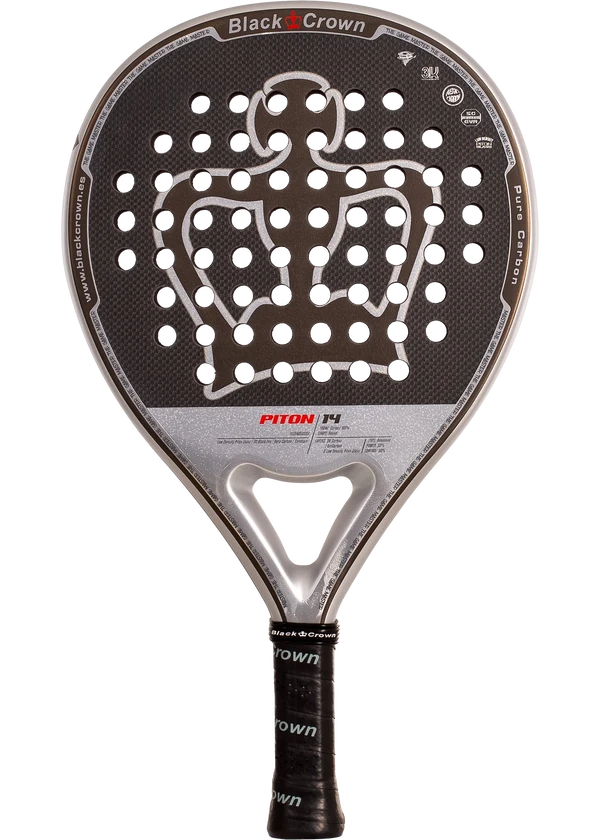

8 Parameters
Piton 14 2025
On this page
Review
Black Crown Piton 14 2025 Review — The Defender’s Dilemma Solved?
The hardest decision in padel equipment isn’t between power and control — it’s between control and everything else you quietly give up to get it. The Black Crown Piton 14 2025 enters that argument by refusing to accept the traditional costs: it chases defender-level precision while keeping playability high enough for players who don’t just defend. The question isn’t whether this is a defensive racket. The question is whether it’s only a defensive racket.
Built around a 15-degree SC Black EVA medium-soft foam core with Black Crown‘s Low Density Piton Glass technology, the Piton 14 2025 pairs a round shape with 3K carbon faces finished in Sandspin — a roughened texture engineered for spin retention on defensive shots. The frame uses Aero Carbon construction, the profile sits at 38mm, and the declared weight range sits between 350–375g depending on source, with no independent measurements available to confirm a single figure. Stiffness is medium, leaning toward the softer side — a deliberate choice that shapes every performance number in this review.
Playability at 8.4 leads the scorecard — matching Maneuverability at 8.4, above Control at 8.3. Defender: 8.22 · Hybrid: 8.11 · Attacker: 7.55. The 0.67-point gap between Defender and Attacker profiles is the whole editorial: this racket has a clear preferred role, and it isn’t finishing.
Performance Breakdown
How the Black Crown Piton 14 2025 Plays
SWEETSPOT SIZE 8.1
Precision Without the Penalty
The round shape and medium-soft EVA core work as a single system — the geometry spreads the sweetspot toward the center of the frame, while the foam’s compliance absorbs the micro-vibrations that typically compromise control under fatigue. Control reaches 8.3, which is exactly where this racket was designed to land: precise from the back without demanding precision from the player. The sweetspot size of 8.1 is notably high for a 3K carbon face — that’s the Low Density Piton Glass doing its work, softening the face response enough to widen the usable hitting zone. Together, these scores confirm a racket that is genuinely forgiving at a playing level where most carbon rackets are not.
PLAYABILITY 8.4
The Two Scores That Redefine the Category
This is the most counterintuitive part of the Piton 14 2025’s profile: for a racket positioned as a defender tool, it is unusually quick and usable. Maneuverability at 8.4 reflects a balance point (260mm) that stays closer to the handle than most competitor rackets in this category, making it responsive at the net — volleys and bandejas come through fast without requiring force. Playability matching that figure at 8.4 means the racket doesn’t punish transitions: defenders who occasionally need to finish a point won’t feel like they’re using the wrong tool. Among round-shaped rackets, this combination of agility and versatility is not the norm.
SPIN 7.6
Arm-Friendly First, Spin as Secondary Benefit
Comfort at 8.2 is a direct consequence of the medium-soft EVA choice — no specific arm fatigue or elbow concerns surface in any technical review, and the dampening profile is clearly intentional for a racket targeting intermediate players who often have accumulated arm stress. Spin sits at 7.6, which is respectable but not the primary selling point: the Sandspin rough finish adds meaningful texture to defensive slices and controlled topspin, particularly when pace is low and contact time is extended. This is spin as a tactical tool, not an offensive weapon. The Piton 14 2025 won’t generate the aggressive rotations of a dedicated spin-focused diamond racket — and it’s not trying to.
STABILITY 7.4
The Trade-Off the Attacker Profile Reflects
Power at 7.2 is the lowest individual score and the primary reason the Attacker profile sits at 7.55 — the Piton 14 2025 will assist finishing shots on volleys and overhead plays, but it doesn’t amplify them. The lively feel from the medium-soft core adds some spring to smashes, but there’s a ceiling here that pure attackers will notice immediately. Stability at 7.4 is adequate for controlled defensive exchanges but confirms the racket favors centered, clean contact over off-center power recoveries — a physical consequence of the round shape and lower balance point. Neither number is a flaw; both are honest expressions of a racket that chose control over raw force.
Technology
Low Density Piton Glass: Does Softer Actually Mean Smarter?
Low Density Piton Glass modifies the face layer between the 3K carbon exterior and the SC Black EVA core. The practical effect is a reduction in face rigidity without sacrificing structural integrity — the ball sits on the face fractionally longer at contact, which has two measurable consequences: the hitting zone widens and vibration transmission toward the grip decreases. These aren’t theoretical benefits. The sweetspot score of 8.1 is unusually high for a carbon-faced racket at this stiffness (RA 45), and the comfort score of 8.2 reflects dampening that doesn’t require additional grip or sleeve compensations.
The 15-degree SC Black EVA core positioning is the second layer of the system. Angling the foam insert changes the way ball energy distributes across the hitting surface during impact — it biases energy return toward the central zone, which reinforces the high sweetspot score while preventing the sharp drop-off in feel that flat-mounted cores can produce toward the frame edges. For a player using the Piton 14 2025 as a back-court defensive tool, this means consistent feedback across a wider range of imperfect contacts — exactly what intermediate-to-advanced players need under pressure.
Sandspin completes the system by addressing the one area Low Density Piton Glass and the EVA core can’t solve: surface friction. The roughened 3K carbon face generates bite on contact, adding 7.6 in spin — a figure that makes defensive slices genuinely directional rather than passive. The beneficiary is the player who defends deep and relies on spin to neutralize pace rather than simply returning it flat. This system was built for that player, and the scores confirm it works.
Player Fit
Who Should Buy the Black Crown Piton 14 2025?
The Back-Court Builder Who Occasionally Attacks
If you’re the type who wins points by outlasting opponents — by keeping the ball in play, placing it accurately, and waiting for the mistake — the Piton 14 2025 was profiled around your game. The 8.3 in Control and 8.4 in Playability mean your back-court consistency translates directly, not incidentally. The 8.4 Maneuverability means net exchanges don’t expose you the moment you step forward. And the 8.1 sweetspot means the racket doesn’t abandon you when the contact isn’t perfect — which is most of the time, at most playing levels. This is the racket for the intermediate-to-advanced player who wants a tool that’s genuinely dialed in without needing to be dialed in themselves.
The Player Who Finishes Points, Not Prolongs Them
If your game is built around winning points at the net — smashes, viboras, aggressive volleys — the Piton 14 2025 will feel like a ceiling you can’t punch through. Power at 7.2 is the lowest score in the profile, and the Attacker score of 7.55 sits 0.67 points below the Defender score. The round shape and lower balance point physically cap the kind of momentum transfer that finishers depend on. Stability at 7.4 also means off-center power plays won’t reward you the way a diamond-shape frame would. The racket isn’t broken for attackers — it’s just not optimized for them, and you’ll feel that every time you look for more.
FAQ
Frequently Asked Questions
What is the PadelVerdict score for the Black Crown Piton 14 2025?
The PadelVerdict score is 8.4, with a Consensus Modifier of +0.1 applied. Specs appear consistently across multiple sources (Data Quality: neutral), specialist sources across multiple markets align tightly on shape, core, surface, and technology with no contradictions found (Field Validation: positive), but no independent physical measurements exist to go further (Market Correction: neutral). Profile breakdown: Defender 8.22 · Hybrid 8.11 · Attacker 7.55. That 0.67-point gap between Defender and Attacker confirms the racket has a clearly preferred role — buy accordingly.
Is the Black Crown Piton 14 2025 good for intermediate players?
Yes — and more specifically, it’s designed for them. The sweetspot at 8.1 and comfort at 8.2 directly address the two pain points of intermediate players: inconsistent contact and arm fatigue. The playability score of 8.4 means the learning curve is low. If you’re intermediate and primarily defensive in orientation, this is a strong fit. If you’re intermediate but primarily attacking, the power ceiling at 7.2 will eventually feel limiting.
Is the Black Crown Piton 14 2025 good for defenders?
Yes. It leads the profile rankings with a Defender score of 8.22, supported by Control at 8.3, Maneuverability at 8.4, and a sweetspot that doesn’t punish off-center contact. The round shape and low balance point are exactly what back-court play demands. If you identify as a defensive player, this racket confirms your instinct. Browse all defender rackets to compare alternatives at your level.
What is the actual weight of the Black Crown Piton 14 2025?
The declared weight is 363g, but manufacturer ranges across sources vary between 350–375g — a 25g spread that is wide enough to be perceptible on court. No independent measurements are available to confirm which end of that range individual units actually land on. At the midpoint of the range, the racket feels balanced and manageable; toward the upper end, it adds a hint of stability but reduces the quick-handling feel that makes the Maneuverability score of 8.4 meaningful.
How does the Black Crown Piton 14 2025 compare to the Piton White 2025?
These are two different player types sharing the same family name. The Piton 14 2025 is the control-first option — softer core, wider sweetspot, designed to extend rallies and reward precision. The Piton White uses a different core and face combination that shifts the balance toward a livelier, more offensive feel. Choose the Piton 14 if your game is built from the back. Choose the Piton White if you want that same brand DNA but with more finishing capability at the net. Neither is superior — they answer different questions.
Why does the Black Crown Piton 14 2025 have a Consensus Modifier of +0.1?
The +0.1 reflects something specific about how the data aligned, not just that it existed. Consistent specs across sources alone wouldn’t move the modifier — that’s the neutral baseline. What earns the positive adjustment here is specialist-level convergence across multiple markets: shape, core technology, surface finish, and performance characteristics all align without contradiction, including detailed parameter-level scoring from a specialist source that maps directly onto the technical profile. The modifier stays at +0.1 rather than going further because no independent physical measurements of weight, balance, or stiffness exist to validate the declared figures. That confirmation is what would be required to go higher.
Similar Rackets
Independent testing, funded by readers
No brand deals, no sponsored picks. If you found this useful, you can support the next round of tests with a small tip.

