
Gladius 2026
Does Versatility Have a Ceiling?
The short verdict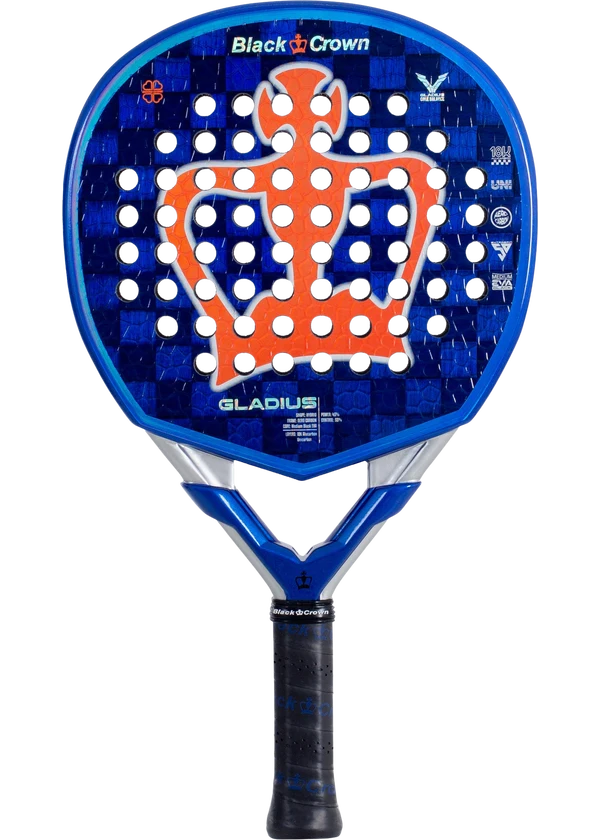

8 Parameters
Gladius 2026
On this page
Review
Black Crown Gladius 2026 Review — Does Versatility Have a Ceiling?
The hardest racket to design is not the best attacker or the most forgiving defender — it’s the one that refuses to choose. Hybrid rackets invite a specific kind of skepticism: if you’re good at everything, are you truly excellent at anything? The Black Crown Gladius 2026 walks directly into that tension, positioning itself as a complete weapon for players whose game doesn’t fit neatly into one lane.
Built around a Medium Black EVA foam core and 18K carbon faces with a 3D extra spin roughness texture, the Gladius 2026 sits in a drop shape — lower sweetspot than a round, more accessible than a diamond. The unidirectional carbon frame runs at 38mm profile, and the proprietary Gladius Core Balance system is designed to distribute mass with handling in mind. Stiffness lands in medium-hard territory, measured at 58 RA — firm enough to transfer pace, compliant enough to absorb defensive contact. This is a men’s, intermediate-to-advanced model in Black Crown’s 2026 lineup, distinct from the harder-core Gladius Force variant.
Control leads at 8.3 — the highest parameter in the set. The gap between the top and bottom profiles is just 0.18 — tight enough that player style, not profile label, should drive the decision.
Performance Breakdown
How the Black Crown Gladius 2026 Plays
SWEETSPOT 8.0
The Racket’s Strongest Hand Is Precision
The Medium Black EVA core absorbs pace without turning it to noise — shots from the baseline come back with intention, not just with force. Control at 8.3 is the headline number, and the 8.0 sweetspot confirms there’s real estate to work with: the hitting zone sits slightly above center, which rewards a compact, clean swing over a looser one. What’s notable is how the sweetspot interacts with the drop shape — on a diamond you’d expect tighter margins, but the Gladius 2026 distributes forgiveness generously enough for structured rally play to feel natural rather than demanding. The 18K carbon surface translates hand feel cleanly at medium speed, giving back the kind of tactile feedback that lets players adjust between shots.
PLAYABILITY 7.9
Power Doesn’t Lead — It Supports
Power at 7.8 is the number that clarifies the racket’s intent: this is not a smash weapon, it’s a structured play tool. The medium-hard stiffness generates enough zip on volleys and flat finishes near the net to threaten, but attackers looking for maximum exit velocity will find the ceiling lower than a diamond-shaped hard-core alternative like the Gladius Force. Playability at 7.9 tells a reassuring story for the target player — the racket doesn’t punish you for being one step late, and it transitions between defensive and offensive phases without demanding a full technical reset. For intermediate-level players building tactical patterns rather than relying on raw pace, that combination is precisely what the design intends. Among drop-shaped rackets, this power-to-control balance sits right at the versatile midpoint.
STABILITY 7.6
Agile Enough, But Not Effortless in a Firefight
At the declared 360–370g range, the Gladius 2026 handles acceptably without being fast in the wrist-flick sense that reactive defenders need. Maneuverability at 7.8 is solid for structured net play and patient exchanges, but under pressure at close range the racket asks for technique — loose mechanics amplify contact errors rather than absorbing them. Stability at 7.6 is the lowest parameter in the set, and it’s the honest trade-off for what the medium balance point delivers in comfort: the frame doesn’t twist catastrophically on off-center hits, but it doesn’t lock them down either. That stability score is also what keeps the Defender profile, despite leading at 8.01, from becoming a runaway recommendation for pure back-court specialists — the racket suits defensive use as part of a complete game, not as a primary identity.
COMFORT 7.4
Spin Is Real, Comfort Has Conditions
The 3D extra spin roughness texture on the 18K carbon face does measurable work: topspin and slice feel intentional rather than incidental, and at 7.6 spin is a genuine tactical option without being the defining attribute of the racket. Comfort at 7.4 is the parameter worth watching — it’s the lowest in the set, and with medium-hard stiffness at 58 RA, players who spend long sessions in defensive exchanges or who already manage arm sensitivity should treat this as a relevant signal. The EVA core buffers impact more than a full-carbon construction would, but the overall vibration profile is firm rather than plush. Players with healthy arms at intermediate level will find it manageable; those recovering from elbow issues should consider softer alternatives first.
Technology
Gladius Core Balance: Does Redistributing Mass Actually Change Anything?
The Gladius Core Balance system is Black Crown’s approach to managing the weight distribution inside the frame — rather than letting mass settle where construction dictates, the system is designed to place it where the playing characteristics demand. The result is a medium-high balance point that keeps swing weight from becoming a liability without pushing the sweetspot too high for the drop shape to handle. That’s a meaningful engineering decision, and the 7.8 Maneuverability score reflects it: the racket moves with more fluency than its 365g declared weight might suggest, because the balance point works in favour of the swing rather than against it.
The 18K carbon unidirectional frame construction contributes directly to the 8.3 Control score — higher-weave carbon at the face transfers deformation energy more consistently than mixed constructions, which means the ball stays on the face fractionally longer at the contact point. That dwell time is what gives precision to flat drives and trajectory stability to lobs. It also interacts with the 3D extra spin roughness: the texture bites into the ball on lateral brush contacts, delivering the 7.6 Spin score with enough margin to make topspin a weapon rather than a bonus. The trade-off is the 7.4 Comfort score — medium-hard carbon frames at 58 RA are not arm-friendly by design, and the EVA core does the buffering work. For the intended intermediate-to-advanced player who generates their own pace, the system earns its complexity. For players who rely on the racket to generate pace for them, it asks for more than it gives back.
Where the Core Balance system is most visible is in the Stability-versus-Maneuverability trade-off. By keeping weight central rather than peripheral, the system favours nimbleness over block-and-lock stability — hence Stability at 7.6 trails Maneuverability at 7.8. That’s a deliberate product decision, not an oversight: it says this racket is built for players who move through shots, not through them.
Player Fit
Who Should Buy the Black Crown Gladius 2026?
The Complete Player Who Wins Through Structure
If you’re the type who builds points through positioning and shot selection rather than raw power — who wants to drop a clean lob from defense and be on the net two shots later — the Gladius 2026 was designed around your game. The 8.3 Control and 8.0 Sweetspot scores mean your tactical patterns arrive where you intend them. The 7.9 Playability score tells you the racket transitions with you rather than forcing you to adapt to it. With a profile spread of just 0.18 between Defender and Attacker, this is genuinely an all-court tool — not a label, a measurement. You’re the player who’s been waiting for something that doesn’t force you to choose between defending well and finishing cleanly.
Pure Attackers Who Need Maximum Exit Velocity
If your game is built on smash-and-close, the Gladius 2026’s Attacker score of 7.83 is the lowest of the three profiles — and Power at 7.8 is the honest ceiling. The medium-hard core gives you precision, but it won’t catapult the ball. Stability at 7.6 also means the frame doesn’t reward aggressive off-center contact as a tool. This is a controlled racket that asks you to earn pace through technique, not borrow it from the frame. If you’re after a more power-first drop shape, the Gladius Force 2026 is the sibling that answers that brief without asking you to give up Black Crown’s construction quality.
FAQ
Frequently Asked Questions
What is the PadelVerdict score for the Black Crown Gladius 2026?
The PadelVerdict score is 8.1, which includes a Consensus Modifier of +0.1. Specs are consistent across multiple sources (Data Quality: neutral), specialist sources across multiple markets align on shape, core, surface, and weight with no contradictions found (Field Validation: positive), but no independent physical measurements exist to go further (Market Correction: neutral). Profile breakdown: Defender 8.01 / Hybrid 7.97 / Attacker 7.83. The 0.18 gap between top and bottom profiles means player style matters more than the label on the box.
Is the Black Crown Gladius 2026 good for intermediate players?
Yes — with one condition. The 7.9 Playability score means it rewards clean fundamentals rather than compensating for loose mechanics. If you’re an intermediate player building structured patterns with a consistent swing, this is an excellent fit. If you’re still developing technique and need forgiveness on mishits, a softer or more round-shaped option would serve you better in the short term.
Is the Black Crown Gladius 2026 good for hybrid players?
Yes. With a Hybrid score of 7.97 and just 0.18 separating all three profiles, this is exactly the kind of racket the hybrid racket category is built around. Control at 8.3 and Playability at 7.9 mean you can defend without sacrificing the option to finish. It won’t be your best smash racket, but it won’t let you down at the net either.
What is the actual weight of the Black Crown Gladius 2026?
Declared weight is 365g, but figures vary across sources from 355g to 375g — a 20g spread that is perceptible on court. No independent scale measurements exist to narrow it further. If you’re sensitive to weight consistency, treat the range rather than the single figure as the real spec. At the heavier end of that range, the racket will feel meaningfully different in extended play.
How does the Black Crown Gladius 2026 compare to the Gladius Force 2026?
The choice between them is a choice between player identities, not feature lists. The Gladius 2026 uses a Medium Black EVA core and prioritizes control and all-court versatility — it suits players who build points through structure and precision. The Gladius Force 2026 uses a harder core and is oriented toward power and offensive aggression. If your game finishes at the net with pace, Force. If your game wins through placement and patience, Gladius 2026.
Why does the Black Crown Gladius 2026 have a Consensus Modifier of +0.1?
The +0.1 reflects one specific element: specialist sources across multiple markets converge on the same core details — shape, core density, surface material, weight range — without contradiction. That level of cross-market alignment on technical specifics is what earns the positive adjustment, not simply the fact that specs exist. The ceiling stays at +0.1 because no independent physical measurements have been made to confirm declared figures directly. A verified on-scale weight or independent stiffness measurement would support going further.
Similar Rackets
Independent testing, funded by readers
No brand deals, no sponsored picks. If you found this useful, you can support the next round of tests with a small tip.

