
Bomba Soft 2026
The Comfort Case for a Diamond Shape
The short verdict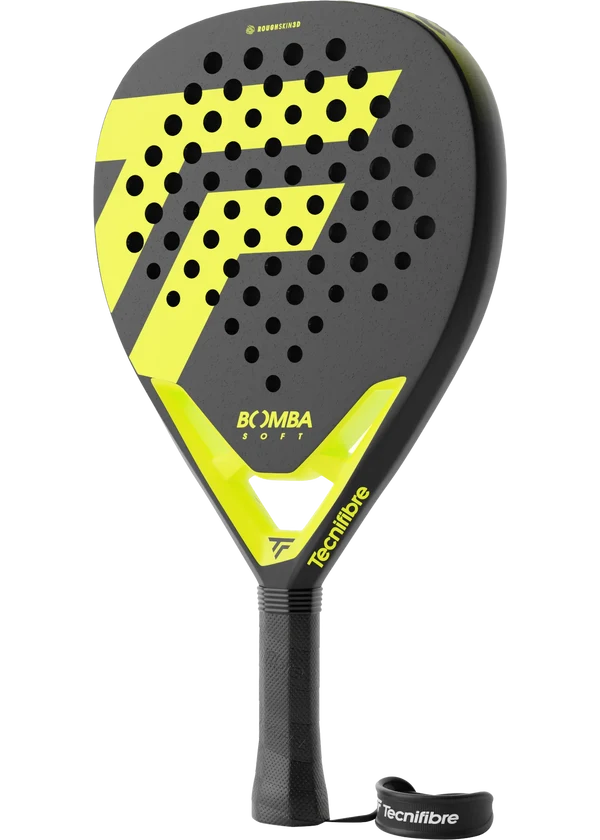

8 Parameters
Bomba Soft 2026
On this page
Review
Tecnifibre Bomba Soft 2026 Review — The Comfort Case for a Diamond Shape
Diamond rackets carry a reputation problem: power at the cost of everything else. The Tecnifibre Bomba Soft 2026 is a deliberate challenge to that assumption — a diamond-shaped racket built around soft foam and a mixed carbon-fiberglass surface, engineered not for the hard hitter looking for a weapon, but for the intermediate player who wants offensive geometry without paying for it with their elbow.
The Bomba Soft sits at the accessible end of Tecnifibre’s 2026 lineup, positioned below the full-carbon Bomba Max. Its core is a soft foam monobloc — notably denser than air-foam alternatives — wrapped in a hybrid surface of carbon and fiberglass with a Rough Skin 3D texture for grip. The 38 mm frame profile keeps the structure within standard hybrid dimensions, while the 355 g declared weight and 265 mm balance sit in medium-high territory for a diamond. Stiffness is rated at 35 RA, confirming a genuinely soft flex that absorbs rather than deflects impact energy.
Comfort leads at 8.3 — the highest single parameter in this racket. Hybrid profile scores 8.07, Defender 8.05, Attacker 7.74. The narrow gap between Hybrid and Defender tells the real story: this diamond plays far more like an all-court tool than the shape suggests.
Performance Breakdown
How the Tecnifibre Bomba Soft 2026 Plays
PLAYABILITY 8.2
The Soft Foam Does What Stiff Carbon Won’t
The racket’s defining quality is the one that most diamond players sacrifice first. A 35 RA stiffness rating combined with a soft foam monobloc produces a progressive flex at impact — the energy disperses across the core rather than spiking through the frame into your wrist and elbow. Comfort at 8.3 is the top score in this racket, and the 8.2 Playability sits directly beside it because these two parameters reinforce each other: a racket that doesn’t fatigue you lets you play longer, more accurately, and with more confidence under pressure. For intermediate players logging long sessions or managing arm sensitivity, this pairing is the primary argument for the Bomba Soft.
CONTROL 8.0
Light Enough to Defend, Precise Enough to Direct
The Bomba Soft comes in 5–10 grams lighter than the Max variant, and that reduction has a measurable effect on court. Maneuverability at 8.2 is unusually high for a diamond shape in this balance range — the aerodynamic perforations in the frame reduce drag enough to make net reflexes and direction changes feel accessible rather than forced. Control follows at 8.0, which is the counterintuitive result of the soft foam absorbing micro-vibrations at the moment of contact: trajectory precision improves when the racket isn’t bouncing feedback noisily through the frame. These two scores are what push this racket firmly into diamond racket territory without the usual hybrid-to-diamond tradeoff in feel.
SWEETSPOT SIZE 7.8
Diamond Power, Moderated by Design
Power at 7.8 reflects the structural compromise this racket makes to achieve its comfort scores: a softer core absorbs some of the energy that a full-carbon construction would project back into the ball. The number isn’t weak — the diamond geometry and high balance still generate heavier shots than a round or teardrop — but it isn’t the explosive return you’d get from the Bomba Max. Sweetspot Size also lands at 7.8, which is the upside of the expanded head geometry: the fiberglass surface creates a larger, more forgiving contact zone than full-carbon equivalents at the same shape.
STABILITY 7.2
The Gap the Attacker Score Explains
Spin at 7.4 is the weakest parameter, and it’s the most honest signal about this racket’s ceiling. The Rough Skin 3D texture contributes grip and bite at contact, but the soft foam core limits the snap-through that aggressive topspin and slice shots require — the ball stays on the surface slightly longer than ideal for high-rotation strokes. Stability at 7.2 is the lowest score, and it directly accounts for the Attacker profile trailing at 7.74: when an off-center impact arrives on a smash or aggressive drive, the frame gives a little where a stiffer construction would hold. These two parameters together define who this racket is not built for — and they’re exactly what separates the Hybrid score (8.07) from the Attacker score (7.74).
Technology
Rough Skin 3D and Soft Foam: Comfort Engineering or Marketing Packaging?
The Tecnifibre Bomba Soft 2026 doesn’t rely on a single headline system — it layers three separate construction decisions that each address a specific performance gap. The Soft Foam monobloc core is the most consequential. At 35 RA stiffness, the progressive deformation at impact distributes force across the full core rather than concentrating it at the contact point. This is directly measurable in the Comfort score (8.3) and indirectly visible in Control (8.0) — a softer core reduces the micro-bounce effect that produces imprecise trajectories on off-center contacts.
The Rough Skin 3D surface texture adds mechanical grip to the ball at contact, working through a sand-painted finish rather than a molded pattern. The result shows in Spin at 7.4 — meaningful contribution, but limited by what the soft core underneath can deliver in snap-through energy. The texture helps most on defensive lobs and controlled mid-court rallies where placement matters more than rotation. For aggressive topspin from the back court, the surface grip is the ceiling, not the floor.
The X-Speed aerodynamic perforation system in the frame profile addresses the one area where diamond shapes traditionally penalize intermediate players: swing speed under pressure. The perforations reduce air resistance through the frame structure, which is what drives the Maneuverability score to 8.2 — unusually high for a diamond at this balance point. At the net, on reactive volleys, and in fast exchanges, this is the technology that makes the Bomba Soft feel lighter than its 355 g declared weight suggests.
X-Top aramid fiber reinforcement at the top of the frame adds structural integrity where smash impact stress concentrates. It partially compensates for the soft core’s lower stability — but only partially, which is why Stability still sits at 7.2. The honest conclusion: the technologies work cohesively for the player they’re designed for. They do not transform the Bomba Soft into something it isn’t. Players managing arm issues or building their game in the intermediate range will find every system earns its place.
Player Fit
Who Should Buy the Tecnifibre Bomba Soft 2026?
The Intermediate All-Court Player Who Wants More Without Risking More
If you’re the type who plays three or four times a week, enjoys pressing from mid-court and the net, and has started to feel that your round or teardrop racket isn’t giving you enough on your smashes — this is the upgrade path that won’t cost you your elbow. The Hybrid profile score of 8.07 and Comfort of 8.3 confirm a racket that rewards consistent, all-court play without demanding technical perfection. The 8.2 Maneuverability means you won’t be late on volleys despite the diamond shape. And if you’ve ever had to sit out a week with tendinitis, the 35 RA soft core is designed specifically to prevent that conversation from happening again.
Advanced Attackers Who Need a Weapon, Not a Safety Net
The Attacker score of 7.74 is the honest answer here. If you’re an advanced player whose game is built on maximum power, explosive spin, and frame stability on hard smashes from the back court, the Bomba Soft will feel like it’s working against you. Stability at 7.2 — the lowest parameter in the rack — means off-center high-impact shots lose authority rather than punch through. Spin at 7.4 confirms the soft core can’t generate the ball rotation that aggressive top-court play demands. The Bomba Max is the correct answer if raw output is the priority, not forgiveness.
FAQ
Frequently Asked Questions
What is the PadelVerdict score for the Tecnifibre Bomba Soft 2026?
The overall PadelVerdict score is 8.2, with a Consensus Modifier of 0 applied. Specs are consistent across multiple sources (Data Quality: neutral), declared figures show no implausible outliers (Field Validation: neutral), but no independent physical measurements exist to confirm them (Market Correction: neutral). Consistent data without independent validation earns neutral, not positive. Profile breakdown: Hybrid 8.07, Defender 8.05, Attacker 7.74. The 0.33-point gap between Hybrid and Attacker is the purchase decision in one number.
Is the Tecnifibre Bomba Soft 2026 good for intermediate players?
Yes, directly and by design. Playability at 8.2 and Comfort at 8.3 are the two parameters that matter most at the intermediate level, and both score at the top of this racket’s range. The soft foam core and 35 RA stiffness reduce arm fatigue across long sessions. If you’re an advanced player, those same parameters signal a ceiling — look at stiffer options with higher Stability scores instead.
Is the Tecnifibre Bomba Soft 2026 good for hybrid players?
Yes. The Hybrid profile score of 8.07 is the highest in the rack, and the supporting parameters back it up: Maneuverability 8.2, Control 8.0, and Comfort 8.3 together describe a racket that rewards versatile, all-court play. If that matches your game, check all hybrid racket options for comparison.
What is the actual weight of the Tecnifibre Bomba Soft 2026?
The declared weight is 355 g. No independent measured weight is available for this model — no on-camera weigh-ins or lab data exist at this time. The declared figure is consistent across multiple sources with no contradictions found. At 355 g with a 265 mm balance, the racket sits on the lighter end of diamond rackets in this category, which aligns with its Maneuverability score of 8.2. Independent measurements would support a more precise verdict.
How does the Tecnifibre Bomba Soft 2026 compare to the Bomba Max?
These are two answers to the same diamond shape, built for different players. The Bomba Max is full-carbon, heavier by approximately 10 g, stiffer, and built to maximize power output and frame stability on aggressive shots. The Bomba Soft trades those qualities for a softer impact feel, better arm protection, and easier maneuverability. Choose the Max if your game is built on firepower. Choose the Soft if session length, arm health, and placement matter more than maximum ball speed.
Why does the Tecnifibre Bomba Soft 2026 have a Consensus Modifier of 0?
The specs for this racket — shape, core, surface, weight, balance — appear consistently across multiple sources with no contradictions. That earns a clean data baseline, but consistency alone doesn’t move the modifier above zero. What would move it is independent physical validation: on-camera weigh-ins, measured balance points, or specialist cross-market convergence going beyond retailer descriptions. None of that exists for this model. Consistent data without independent validation earns neutral, not positive.
Similar Rackets
Independent testing, funded by readers
No brand deals, no sponsored picks. If you found this useful, you can support the next round of tests with a small tip.

