
8 Parameters
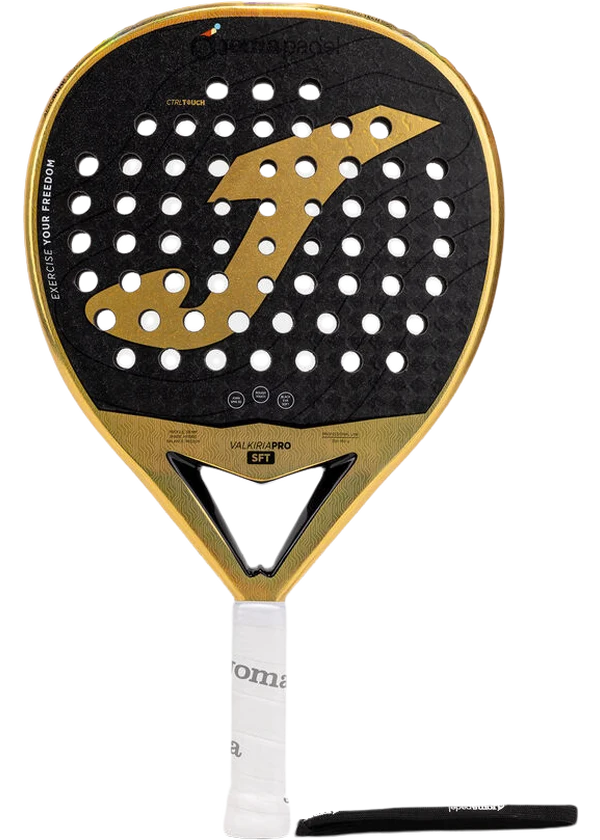
Valkiria Pro SFT 2026
On this page
Review
Joma Valkiria Pro SFT 2026 Review — Is Control This Complete Worth the Trade-Off?
The modern defender’s dilemma is this: every gram of extra control you demand costs you something — power, aggression, the ability to turn a point around when the rally demands it. The rackets that resolve this tension cleanly are rare. Most round-shaped, low-balance designs give you the control and take the rest. The Joma Valkiria Pro SFT 2026 is built to argue otherwise — a racket that frames itself as a complete defensive tool rather than a specialist compromise.
The construction is layered and deliberate. The core is BlackEVA SFT, a high-density foam calibrated toward the softer end of the medium-hard spectrum — designed to absorb energy without sacrificing responsiveness. The surface is 12K carbon fiber finished with Joma’s 3D Spin texture, a three-dimensional relief designed to generate topspin and slice without demanding technique adjustments. The Dualtech Frame combines a tubular 100% carbon structure with a flat section mixing fiberglass and 12K carbon, while two proprietary systems — Ctrl Touch (intelligent perforation redistributing weight and face flexion) and Aerobump Tech (aerodynamic grooves along the frame) — work on feel and swing speed respectively. Weight sits between 350–360g declared, though some sources extend that range to 355–365g. Balance is notably low at 252mm, firmly in defender territory. The Valkiria Pro SFT exists within Joma’s 2026 lineup as the softer, more comfort-oriented counterpart to the HRD variant.
Control leads at 8.3 — the highest parameter in this racket’s profile. Attacker 7.28 / Hybrid 7.92 / Defender 8.09. The 0.81-point gap between Defender and Attacker scores is the widest spread in this review — a deliberate racket with a clear purpose and a clear ceiling.
Performance Breakdown
How the Valkiria Pro SFT 2026 Plays
SWEETSPOT 8.1
The Core Promise Delivered in Two Numbers
This is what the Valkiria Pro SFT is built around, and the scores confirm the architecture works. The Ctrl Touch perforation system redistributes face flexion rather than just stiffening it — the result is a hitting surface that communicates placement without punishing off-center contact. Control at 8.3 is the highest parameter on this racket, while Sweetspot Size at 8.1 explains how that control stays accessible even under pressure. The round shape’s geometry contributes the forgiving contact zone; the Dualtech Frame keeps response consistent from edge to center.
PLAYABILITY 8.2
The Surprise: It Moves Like It Weighs Less
Here is where the Valkiria Pro SFT earns its differentiation from generic defensive rackets. At a declared weight of up to 360g, Maneuverability at 8.2 is genuinely counterintuitive — most rackets in this weight band trade agility for stability. The Aerobump Tech grooves along the frame reduce aerodynamic drag through the swing arc, and the low 252mm balance point moves the effective mass back toward the handle, making the racket feel faster than its specs suggest. Playability at 8.2 reinforces this: the racket responds well across shot types, and the two-handed backhand in particular benefits from the low balance and quick repositioning the frame allows.
STABILITY 7.5
Arm-Friendly, But Not Unstoppable
The SFT designation exists for a reason: the BlackEVA SFT foam is calibrated to absorb vibration rather than redirect it, and Comfort at 7.9 reflects that design intent clearly — this is a racket you can play long matches with without accumulating arm fatigue. Stability at 7.5 is the softest number in the profile, and it matters for context: it’s sufficient for baseline rallies and controlled defensive positions, but against heavy, off-center impacts — aggressive net attackers forcing angles — the frame shows its limitations. The Stability gap relative to Control is the honest price of prioritizing feel over rigidity.
POWER 6.8
Effects Are a Tool, Power Is the Cost
The 3D Spin textured finish generates useful topspin and slice — Spin at 7.4 places it solidly in the functional range for a defensive round-shaped racket, and players who rely on trajectory variation to build points will find the surface cooperative. Power at 6.8 is where the trade-off crystallizes: this is the lowest score on the racket, and it reflects the deliberate combination of low balance, soft core, and control-first geometry. The Valkiria Pro SFT does not generate power — it expects you to redirect it. Players whose game depends on generating pace from the back will find this ceiling real and consistent.
Technology
Ctrl Touch + Aerobump Tech: Two Systems, One Coherent Philosophy
Ctrl Touch is the more consequential of the two systems. Rather than simply stiffening the hitting face or softening it uniformly, it uses a specific perforation pattern to redistribute both weight and face flexion across the surface — the goal being a hitting zone that feels consistent and communicative without requiring the player to find a small, unforgiving sweetspot. The output shows up directly in the Control score of 8.3 and Sweetspot Size of 8.1: these aren’t coincidentally aligned, they’re architecturally connected. The system produces a surface that translates placement intent into ball behavior with minimal distortion.
Aerobump Tech works differently — it’s a frame-level intervention rather than a surface one. The grooves cut into the profile are designed to reduce aerodynamic resistance through the swing, allowing the racket to move faster without reducing mass. The practical result is the Maneuverability score of 8.2, which is genuinely surprising at this weight range. For defenders who need to reposition quickly between shots — recovering from a lob, adjusting for a wide ball — the system provides real swing speed without demanding a lighter racket.
Together, the two systems are coherent rather than competing: Ctrl Touch optimizes the contact moment, Aerobump Tech optimizes the swing arc leading to it. The player who benefits most is one who is already precise — this technology amplifies control and agility rather than compensating for their absence. The BlackEVA SFT core beneath it all completes the picture by prioritizing feel and vibration absorption over raw rebound, which is why Comfort at 7.9 holds up even as Power sits at 6.8.
Player Fit
Who Should Buy the Joma Valkiria Pro SFT 2026?
The Patient Point-Builder at Intermediate Level
If you’re the type who wins points by being in the right position every time rather than by ending rallies with pace, this is your racket. You read the game well, your positioning is consistent, and you trust your placement more than your power — Control at 8.3 and Sweetspot Size at 8.1 validate that instinct and give it a reliable platform. The Maneuverability score of 8.2 means you won’t be caught slow on recovery, even at 355g. Comfort at 7.9 means you can play the full match without managing arm fatigue. If you identify as a defender at intermediate level and you’ve been playing with rackets that feel either too punishing or too vague, the Valkiria Pro SFT is the racket that finally makes the back court feel like an advantage.
The Net-Dominant Attacker Looking for Punch
Power at 6.8 is not a footnote — it’s the attacker profile score telling the story directly at 7.28. If your game is built around net dominance, generating pace from mid-court, or converting with aggressive smashes, the Valkiria Pro SFT will frustrate you every time you need it to produce what it isn’t designed for. The low 252mm balance and soft BlackEVA core are deliberate choices that trade punch for precision. That’s not a flaw — it’s a decision. Attacking players would be better served looking at the Joma Hyper Pro HRD, the power-oriented model in the same 2026 lineup built specifically for the profile this racket declines to serve.
FAQ
Frequently Asked Questions
What is the PadelVerdict score for the Joma Valkiria Pro SFT 2026?
The overall PadelVerdict score is 8.2, adjusted by a Consensus Modifier of +0.1. Specs appear consistently across multiple sources (Data Quality: neutral), specialist sources across multiple markets align on shape, core, surface, balance, and weight with no contradictions found (Field Validation: positive), but no independent physical measurements exist to go further (Market Correction: neutral). That Field Validation component is what earns the +0.1. Profile breakdown: Attacker 7.28 / Hybrid 7.92 / Defender 8.09. The 0.81-point gap between Defender and Attacker is the widest in this review — if you’re not a defender, this number is the answer.
Is the Joma Valkiria Pro SFT 2026 good for intermediate players?
Yes — directly. Playability at 8.2 and Sweetspot Size at 8.1 make this accessible to players still building consistency. The Ctrl Touch system’s forgiving face means errors away from center don’t punish you as harshly as a stiffer racket would. The caveat: intermediate players who generate most of their pace from the racket rather than their technique will hit the Power ceiling at 6.8 quickly. If that’s you, look at a hybrid-profile option instead.
Is the Joma Valkiria Pro SFT 2026 good for defenders?
Yes. Definitively. Defender profile score of 8.09, Control at 8.3, Sweetspot Size at 8.1, and Maneuverability at 8.2 — these aren’t just numbers in alignment, they describe a racket built specifically for how defenders need to play. Quick recovery, precise placement, and arm comfort across long matches are all covered. If you want to explore how it compares in its category, see all defender rackets we’ve reviewed.
What is the actual weight of the Joma Valkiria Pro SFT 2026?
Joma’s primary declared range is 350–360g, though some sources extend that range to 355–365g. No independent measurements exist to confirm either figure. The 10–15g variance between the two ranges is perceptible on court — particularly for players sensitive to balance feel. Until independent measurements surface, budget for a unit that could land anywhere between 350 and 365g.
How does the Joma Valkiria Pro SFT 2026 compare to the Valkiria Pro HRD?
Frame this as a choice between two player types: the SFT is for the defender who prioritizes feel, arm comfort, and forgiving contact — the softer BlackEVA SFT core absorbs more energy and rewards timing. The HRD is for the player who wants more ball exit speed and a firmer response at the cost of some comfort. If you’ve had arm issues or play long matches regularly, SFT. If your technique is clean and you want more directness from the frame, HRD. Neither is a power racket — the difference lives entirely in the feel register.
Why does the Joma Valkiria Pro SFT 2026 have a Consensus Modifier of +0.1?
Consistent data without independent validation earns neutral — that’s the baseline. What moves this modifier to +0.1 is a level of alignment that goes beyond retailer descriptions: specialist sources across multiple markets converge on the same shape, core material, surface construction, balance point, and weight range with no contradictions found. That depth of cross-market consistency is what Field Validation rewards. The ceiling stays at +0.1 because no independent physical measurements exist to push further — confirmed specs, not measured ones, have a ceiling.
Similar Rackets
Independent testing, funded by readers
No brand deals, no sponsored picks. If you found this useful, you can support the next round of tests with a small tip.

