
Bela LS V3 2025
Does Lighter Mean Better?
The short verdict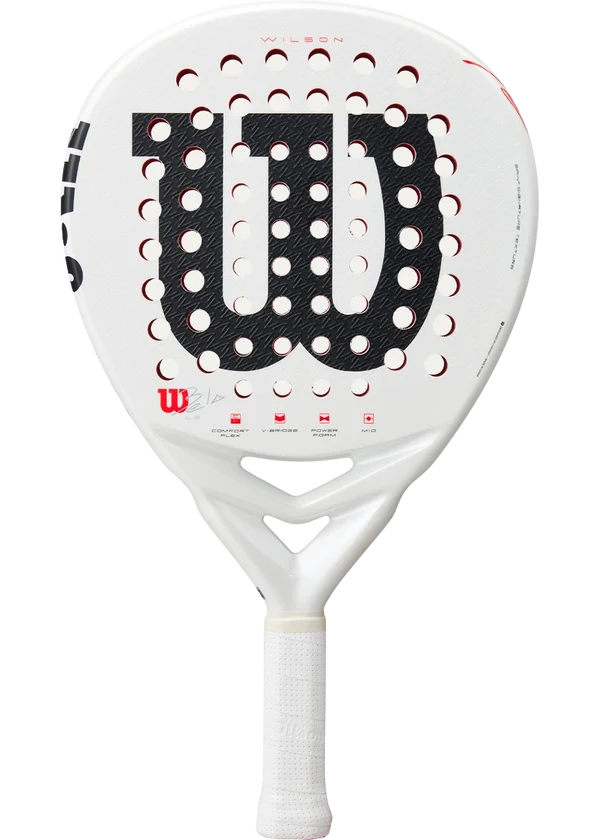


8 Parameters
Bela LS V3 2025
On this page
Review
Wilson Bela LS V3 2025 Review: Does Lighter Mean Better?
The central tension in drop-shaped racket design is almost always the same: players who need arm protection rarely want to sacrifice punch, and players who want punch rarely accept a soft feel. The Wilson Bela LS V3 2025 makes an explicit bet on resolving that conflict — trading the heavier frame of its Bela V3 sibling for 10 fewer grams and a softer hitting surface, then asking whether the lost mass can be compensated by sharper geometry and a redesigned hole pattern. It’s a meaningful trade-off, not a minor revision.
Under the Comfort Flex face sits a Power Foam soft EVA core, rated at a stiffness of 38mm beam width — medium-soft by current standards. The surface is woven carbon fiber with Wilson’s Spin2 dual-density texture, and the frame deploys the V-Bridge geometry for torsional resistance alongside the DuoGrid hole pattern: larger holes toward the top for overhead power, tighter holes in the center for spin and defensive response. At 355g declared weight with a 262mm balance point, it sits at the lighter, more maneuverable end of the Wilson lineup.
Comfort leads at 8.5 — the highest single score on the card. The near-identical Hybrid and Defender readings, separated by just 0.02, tell you this racket doesn’t belong to one player type. The gap that matters is the half-point distance between those two profiles and the Attacker score — that distance defines the racket’s ceiling.
Performance Breakdown
How the Wilson Bela LS V3 2025 Plays
PLAYABILITY 8.3
The Weight Saving Pays Off Here First
The 355g declared weight and low 262mm balance point combine to make this one of the more instinctively responsive drop-shaped rackets in its category. At 8.4, Maneuverability is the second-highest score on the card, and on court it expresses as quicker transitions between volleys and faster recovery after defensive blocks. Playability at 8.3 confirms the accessibility signal — the racket doesn’t ask much of you to get a clean strike. Where the LS earns its name is exactly here: any player switching from a heavier frame will feel the difference within the first rally.
SWEETSPOT SIZE 7.9
A Genuine Arm-Friendly Racket, Not Just a Label
Comfort at 8.5 is the headline number — the single highest score across all parameters. The Power Foam EVA core absorbs vibration efficiently and the Comfort Flex face distributes impact rather than amplifying it, which matters most during long matches or for players managing elbow and shoulder concerns. Sweetspot Size at 7.9 is solid without being exceptional: forgiving enough to reward consistent technique, but not so large that you lose the positional feedback you need to develop. The C2 tubular construction contributes to frame integrity without compromising the soft feel that defines this racket’s identity.
SPIN 7.6
Technically Solid, Never Spectacular
Control at 7.8 and Spin at 7.6 are consistent, dependable scores — not the reason to buy this racket, but not obstacles either. The DuoGrid pattern contributes here in a measurable way: tighter holes in the hitting zone create more dwell time and bite on the ball, while the Spin2 texture adds a second layer of surface friction. The result is a racket that handles defensive redirects and shaped volleys competently without demanding elite technique to produce them. Neither number will impress an advanced player looking for surgical precision, but for the player who needs reliable output across a full match, 7.8 control is exactly functional.
STABILITY 7.2
The Cost of Going Light Is Written Here
Power at 7.4 and Stability at 7.2 are the two lowest scores on the card, and they’re directly connected to the weight reduction decision. Less mass means less momentum transfer on the smash, and a 262mm balance point that sits low in the frame offers less inertia to push through off-pace balls hit from the periphery. Stability at 7.2 is the weakest parameter — the V-Bridge and Stability Channel technologies do real work here, but they can’t fully replace the structural advantage of a 365g frame. This is why the Attacker profile scores half a point below Hybrid: the racket can attack, but it won’t dominate exchanges where raw power decides the point.
Technology
DuoGrid + V-Bridge: Engineering Trade-Offs or a Genuine System?
The DuoGrid hole pattern is the most structurally honest technology in this racket’s spec sheet. Rather than using uniform holes across the hitting face, Wilson distributes two distinct diameters: larger holes in the upper portion of the head create more deflection for overhead smashes, increasing the trampoline effect where power generation typically peaks. Smaller holes concentrated in the center and lower hitting zone create tighter surface response, which directly supports the Control score of 7.8 and contributes to the Spin reading of 7.6 by increasing racket face-to-ball contact time. This isn’t marketing segmentation — the hole distribution maps logically onto how different shots are generated, and the scores reflect it.
The V-Bridge frame geometry addresses the structural weakness that appears whenever a manufacturer reduces racket weight: torsional flex. When mass is removed from the frame, off-center impacts cause more rotational movement at contact, which degrades consistency. The V-Bridge counters this by distributing stress across a wider cross-section of the frame rather than concentrating it at the bridge point. The result shows in the Stability score — 7.2 is not exceptional, but given the 355g weight class, it would likely score lower without the geometry contribution. Think of it as a floor rather than a ceiling: it prevents stability from collapsing, without pushing it into the elite range.
The Spin2 texture adds a dual-density surface layer that works alongside the Sharp Hole drilling system to maximize grip on the ball at contact. Combined with the DuoGrid pattern, this is where the Spin score of 7.6 earns its credibility — it’s a multi-layered system rather than a single surface treatment. Players who generate topspin through technique will find these elements amplify their natural game. Players who rely on flat-hitting will notice the texture less. The technology stack as a whole is most coherent for the hybrid and defensive player who needs variety without mass: the Hybrid score of 8.07 is the honest summary of what it all adds up to.
Player Fit
Who Should Buy the Wilson Bela LS V3 2025?
The Intermediate All-Court Player Who Needs to Last the Match
If you’re the type who plays three times a week, feels it in the elbow by session two, and still wants a racket that can construct points rather than just defend them — this is built for you. The Comfort score of 8.5 is not a coincidence; the entire material stack points toward arm protection without sacrificing speed. Maneuverability at 8.4 and Playability at 8.3 mean you won’t be fighting the racket to respond at the net or reset from defense. The Hybrid profile score of 8.07 confirms what the individual numbers suggest: this is a complete-game racket for a player whose priority is sustainable performance over maximum output. You’ll feel understood every time you pick it up.
The Power-First Attacker Who Wins Points at the Back
If your game lives or dies on the smash and you rely on weight transfer to generate pace, Stability at 7.2 and Power at 7.4 will frustrate you. The Attacker score of 7.53 sits half a point below the Hybrid reading — that gap is exactly the story. This racket won’t amplify an aggressive baseline game; it’ll soften it. Players who need that raw authority from the back of the court should look at the heavier Bela V3 sibling instead, which trades maneuverability for the mass that the LS deliberately removed.
FAQ
Frequently Asked Questions
What is the PadelVerdict score for the Wilson Bela LS V3 2025?
The PadelVerdict score is 8.1, with a Consensus Modifier of +0.05. Profile breakdown: Attacker 7.53 / Hybrid 8.07 / Defender 8.05. The near-identical Hybrid and Defender scores tell you this racket suits two player types equally — the decision point is whether you need power or versatility.
Is the Wilson Bela LS V3 2025 good for intermediate players?
Yes, directly. Playability at 8.3 is the number that answers this: the racket produces consistent output without demanding elite precision at contact. The Comfort score of 8.5 also matters for intermediate players who are still developing efficient swing mechanics — less vibration means less fatigue and less injury risk during that learning phase. If you’re a true beginner, you’d still benefit, but the racket’s real sweet spot is the player with a year or more of structured play.
Is the Wilson Bela LS V3 2025 good for hybrid players?
Yes. The Hybrid profile score of 8.07 is the highest of the three profiles and leads by a meaningful margin over Attacker. Maneuverability 8.4 handles rapid net transitions, Control 7.8 supports ball placement from both wings, and the Sweetspot Size of 7.9 gives you enough tolerance to perform in varied positions. If you play across the court and don’t specialize, this racket fits your game. Browse the full hybrid racket category to compare alternatives.
What is the actual weight of the Wilson Bela LS V3 2025?
Wilson declares 355g with a ±10g tolerance. No independent measured weight data exists for this model — all confirmed figures come from manufacturer and retailer specifications. The balance point shows a minor discrepancy across sources: Wilson’s own documentation lists 260mm while multiple retailers list 265mm. Both fall within the medium-low balance range and the on-court feel difference between those two values is unlikely to be perceptible for most players.
How does the Wilson Bela LS V3 2025 compare to the Wilson Bela V3 2025?
This is a choice between two player priorities, not two similar rackets. The Bela V3 runs 10g heavier at 365g with a 3K carbon fiber surface — that extra mass improves power output and stability for players who finish points aggressively. The LS V3 gives those numbers up in exchange for Comfort 8.5 and Maneuverability 8.4 that the heavier version can’t match. If you prioritize arm health and court coverage over raw smash power, the LS wins. If you want to dominate at the net on your terms, the standard V3 is the more honest tool.
Why does the Wilson Bela LS V3 2025 have a Consensus Modifier of +0.05?
Specs are consistent across multiple sources with no contradictions in core figures — consistency alone, however, does not earn a positive adjustment. What moves the modifier fractionally above zero is the convergence of specialist sources across multiple markets on the same performance characteristics: arm comfort, maneuverability advantage, and versatile profile, without outlier claims that raise red flags. The remaining gap to a stronger positive modifier comes down to the absence of independent physical measurements — declared weight and balance remain unverified by any on-camera source, and that absence keeps the adjustment modest. Independent measurements would support a more meaningful positive adjustment.
Similar Rackets
Independent testing, funded by readers
No brand deals, no sponsored picks. If you found this useful, you can support the next round of tests with a small tip.

