
Bela V3 2025
Can a Drop Shape Serve Every Role?
The short verdict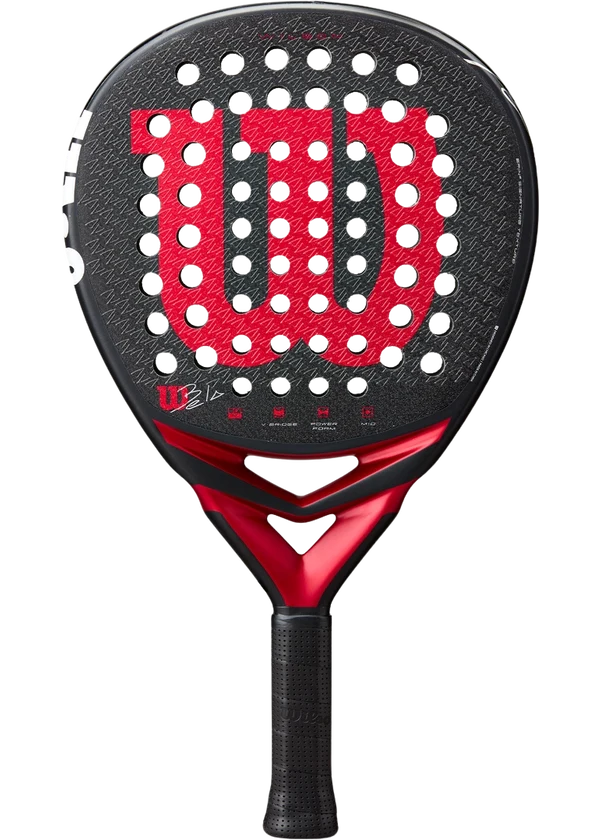


8 Parameters
Bela V3 2025
On this page
Review
Wilson Bela V3 2025 Review: Can a Drop Shape Serve Every Role?
The most persistent argument in padel equipment is whether a racket can genuinely be all things without being nothing in particular. Power specialists give up touch. Control rackets leave attackers cold. The hybrid middle ground is where most players live — and where most rackets quietly disappoint. The Wilson Bela V3 2025 is built specifically to challenge that compromise, co-designed with Fernando Belasteguín to balance explosive attack with consistent defensive touch at an intermediate-to-advanced level.
The specs frame the ambition clearly. A drop shape at 365g, declared balance at 262mm, Power Foam high-density EVA core, and a 3K carbon surface finished with Spin2 texture. The frame integrates Wilson’s V-Bridge geometry — a structural channel at the throat designed to reduce torsional flex — alongside a Duo Grid Sharp Hole pattern: larger holes in the upper zone for overhead punch, smaller ones toward the base for spin bite and volley precision. Stiffness is rated at 62 RA, sitting in firm-but-not-brutal territory. Browse the full Wilson lineup to see how it sits in context.
Control leads at 8.3, with Power close behind at 8.1 — the narrowest gap of any parameter pair. Attacker: 8.00 / Hybrid: 8.03 / Defender: 7.87. The hybrid score edges the attacker score by just 0.03, which means this racket barely has a dominant identity — that’s the whole point of it.
Performance Breakdown
How the Wilson Bela V3 2025 Plays
STABILITY 8.0
Overhead Punch Without Structural Give
Power Foam high-density EVA sits at the core of the Bela V3’s attack game, and the 8.1 here reflects a core that delivers without needing a diamond shape to do it. What makes this interesting is how Stability pairs with it at 8.0: the V-Bridge geometry demonstrably reduces torsional flex at contact, meaning off-center smashes retain more energy than you’d expect from a 262mm balance point. The Duo Grid’s larger upper holes amplify overhead restitution specifically — this isn’t a racket that fires uniformly across the face. The result is an attacking weapon that doesn’t punish mishits as hard as its power score might suggest.
SPIN 8.0
Control Is the Headline — and It Earns It
Control leads all parameters at 8.3, which is the counterintuitive finding from a racket marketed on explosive power. The drop shape naturally lowers the balance point, giving players more time to direct the ball rather than just accelerate it. The Spin2 texture — a 3D rough finish on the 3K carbon surface — contributes an 8.0 Spin score that feeds directly into control: more bite means more predictable ball placement on angled volleys and passing shots. The Duo Grid’s smaller lower holes tighten the response toward the throat, adding precision exactly where defensive exchanges demand it.
PLAYABILITY 7.7
Agile Enough, But Not the Fastest Weapon
At 365g and 262mm balance, the Bela V3 handles respectably — Maneuverability scores 7.8 — but this is where the drop shape’s weight distribution makes itself felt. The racket moves well through the air on groundstrokes and volleys, but players transitioning from lighter setups (the LS V3 variant sits at 355g) will notice the difference in rapid net exchanges. Playability at 7.7 tells a similar story: this is a racket that rewards investment in technique. It’s forgiving on most shots, but demands a degree of racket preparation that absolute beginners won’t yet have. These scores sit at the base of the profile spread — they explain the Defender score of 7.87 versus the Hybrid peak of 8.03.
SWEETSPOT SIZE 7.6
The Trade-Off You Accept for the Power
Comfort at 7.4 is the lowest score on the card, and it’s an honest reflection of a 62 RA stiffness rating. The Power Foam dampens vibration more than a pure carbon core would, and the Sublime Grip adds moisture absorption, but players with chronic arm issues should note that firm feel over extended sessions. Sweetspot Size scores 7.6 — functional but not forgiving — meaning the Duo Grid’s zone-specific engineering rewards hitting in the right area rather than compensating for mishits. These two scores work together: the sweetspot is deliberately calibrated for controlled power, not for arm-friendly forgiveness. Players sensitive to stiffness should compare against softer drop-shaped rackets before committing.
Technology
V-Bridge and Duo Grid: Engineering All-Court Consistency or Just Claiming It?
The V-Bridge is Wilson’s structural answer to a specific problem: drop-shaped rackets tend to sacrifice stability in exchange for maneuverability. By integrating a reinforced geometric channel at the throat, the V-Bridge resists torsional rotation on off-center contact. The measured result shows up directly in the Stability score of 8.0 — unusually high for a racket with a 262mm balance point. That’s not coincidence; it’s the V-Bridge doing exactly what it’s designed to do. Players who rely on flat, deep drives from the back will feel this as reliable energy return even when contact isn’t dead-center.
The Duo Grid Sharp Hole pattern is the more nuanced technology. Rather than uniform hole drilling across the face, Wilson uses larger holes in the upper third and smaller holes below. The upper zone amplifies rebound velocity on overheads — directly feeding the 8.1 Power score. The lower zone tightens racket face response for spin and volley precision, which is visible in both the 8.0 Spin and 8.3 Control outputs. This zone-differentiated approach is what makes the Bela V3 feel different from a standard drop shape that simply uses one core to do everything.
The Spin2 texture on the 3K carbon surface adds the final layer: a 3D rough finish that increases ball contact time just enough to generate predictable rotation without demanding excessive swing speed. This is the technology that makes the control story coherent — spin and precision feed each other on this racket, rather than trading off. The combined system targets hybrid players and attackers who want to build points from the baseline and close at net without changing rackets. If you play a two-position game, these technologies are designed specifically for you.
Player Fit
Who Should Buy the Wilson Bela V3 2025?
The Intermediate-to-Advanced All-Court Player
If you’re the type who builds points from mid-court, closes at the net with a smash, and doesn’t want to switch rackets between roles — this is designed around you. The Hybrid score of 8.03 edges everything else by design, and the Control (8.3) plus Stability (8.0) pairing means your transitions from defense to attack don’t cost you precision. You’re at an intermediate or advancing level, you have enough technique to work the sweetspot consistently, and you want a racket that respects both sides of your game. The Bela V3 2025 is exactly that racket.
Arm-Sensitive Players or Pure Defensive Baseline Grinders
If your elbow or shoulder is a recurring concern, the 7.4 Comfort score is the number that matters most here — and it tells you to look elsewhere. The 62 RA stiffness is firm enough that sustained defensive exchanges, where you’re absorbing pace rather than generating it, will compound over a long session. The Defender score of 7.87 is the lowest profile on the card — not disqualifying, but telling. Pure defensive players who live at the back and redirect pace will find the sweetspot (7.6) unforgiving exactly when they need margin most. The Wilson Bela LS V3, with its lighter 355g build and Comfort Flex face, is the more appropriate choice in that scenario.
FAQ
Frequently Asked Questions
What is the PadelVerdict score for the Wilson Bela V3 2025?
The overall PadelVerdict score is 8.1, with a Consensus Modifier of +0.05. Specs are consistent across multiple markets (Data Quality: neutral), specialist sources across multiple markets align on shape, core, and surface tech with no contradictions found (Field Validation: positive), but no independent physical measurements exist to go further (Market Correction: neutral). That Field Validation component is what earns the +0.05. Profile breakdown: Attacker 8.00 / Hybrid 8.03 / Defender 7.87. The tight gap between Attacker and Hybrid tells you this racket genuinely serves both roles.
Is the Wilson Bela V3 2025 good for intermediate players?
Yes, with a condition. The Playability score of 7.7 means the racket rewards technique rather than compensating for its absence. Intermediate players with consistent stroke mechanics will get full value from the Control (8.3) and Spin (8.0). Players still developing fundamentals should look at rackets with higher Sweetspot Size scores — the 7.6 here means mishits are more costly than on a more forgiving alternative.
Is the Wilson Bela V3 2025 good for hybrid players?
Yes. The Hybrid score of 8.03 is the highest profile score on the racket, and it’s not a coincidence — Control 8.3, Stability 8.0, and Power 8.1 describe exactly the toolset a hybrid player needs. You can build from the back and finish at net without feeling underpowered or imprecise in either phase. Browse all hybrid rackets if you want to compare the Bela V3 against the full category.
What is the actual weight of the Wilson Bela V3 2025?
Declared weight is 365g with a manufacturer tolerance of ±10g. No independent measured weight exists in our data — meaning any unit you receive could plausibly land between 355g and 375g. At the upper end of that range, the difference from the declared spec is perceptible in rapid net exchanges. No weight variance data is available to narrow that window further.
How does the Wilson Bela V3 2025 compare to the Wilson Bela LS V3 2025?
These are rackets for different physical priorities. The Bela V3 is built for power-control balance at 365g with a firm EVA core. The LS V3 drops to 355g and adds a Comfort Flex face, which trades some power restitution for comfort and faster handling. If your game is attack-oriented and your arm is healthy, the Bela V3 is the stronger choice. If you prioritize maneuverability or arm protection over raw punch, the LS V3 serves you better.
Why does the Wilson Bela V3 2025 have a Consensus Modifier of +0.05?
Three components determine the modifier. Data Quality is neutral: specs are consistent across multiple markets with no contradictions, but consistency alone doesn’t earn a positive signal. Field Validation is positive: specialist sources across multiple markets describe the same shape, core material, surface texture, and proprietary technologies with no meaningful discrepancies — that cross-market alignment earns a small upward adjustment. Market Correction is neutral: no independent physical measurements exist to confirm the declared balance or weight precisely. The positive Field Validation component moves the modifier from 0 to +0.05. Independent measurements of balance and weight would support a further positive adjustment.
Similar Rackets
Independent testing, funded by readers
No brand deals, no sponsored picks. If you found this useful, you can support the next round of tests with a small tip.

