
Axe 4 Cybershape
Review
Stiga Axe 4 Cybershape 2026 Review: Maximum Power, Real Cost
The most persistent tension in advanced padel racket design is this: every gram of added stiffness that builds power is a gram that transfers directly to your arm. Manufacturers spend enormous resources trying to resolve that equation, and most fail at one end or the other. The Stiga Axe 4 Cybershape 2026 doesn’t pretend to resolve it — it picks a side decisively, and the performance data confirms exactly which side that is.
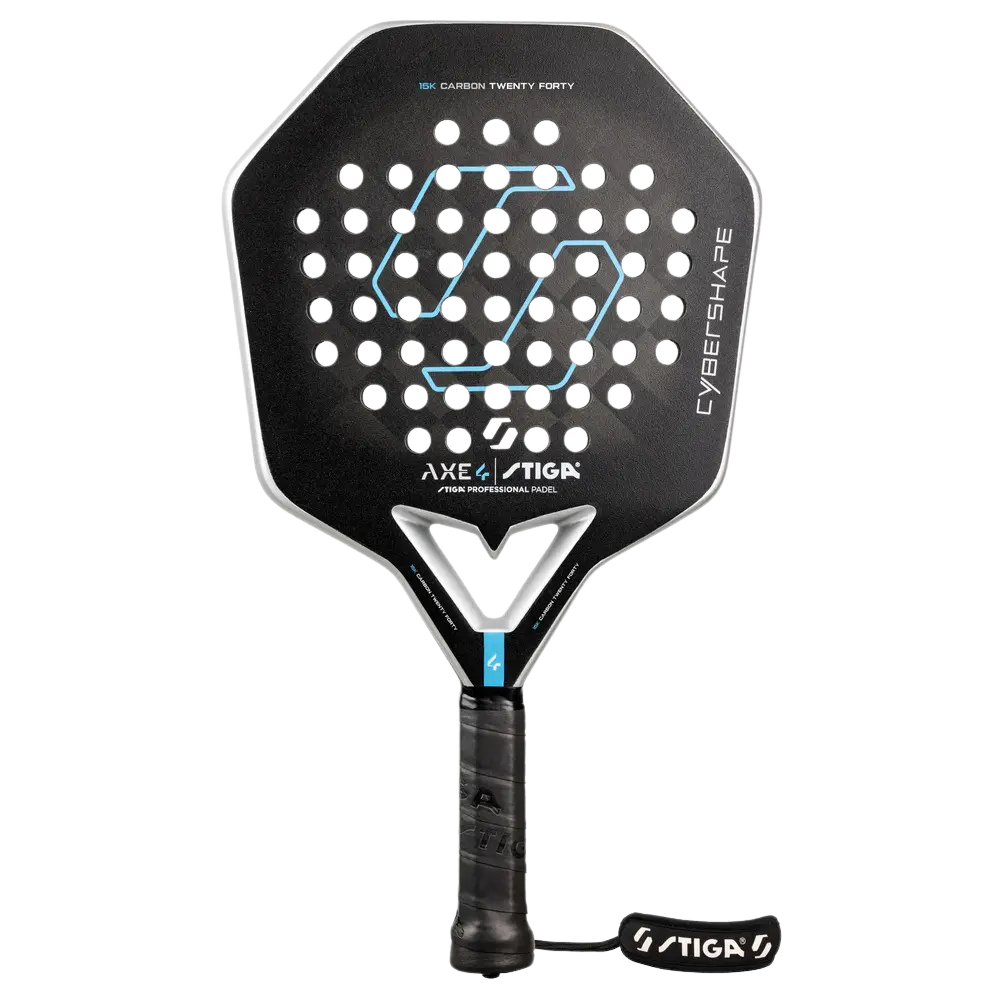
At its core is a hard-density EVA performance foam — stiffer and denser than the Axe 3 it replaces — wrapped in a 15K woven carbon fiber surface with a rough texture built for spin. The 360° carbon frame runs the full perimeter at a 38mm profile, reinforced with TeXtreme® technology for torsional resistance and vibration management. The shape itself is the headline: the Cybershape is a hexagonal geometry — validated by the KTH Royal Institute of Technology — that Stiga claims delivers 20% more sweet spot area than a round racket and up to 12% less air resistance than traditional diamond shapes. Browse the full Stiga racket lineup to see where this sits in their 2026 hierarchy.
Comfort scores 5.8 — the lowest parameter in this profile, and the number that defines the boundaries of who this racket is for. Attacker: 8.15 / Hybrid: 7.56 / Defender: 7.14. A 1.0-point gap between the top and bottom profiles tells you everything: this is a specialist tool, not a versatile one.
Performance Breakdown
How the Axe 4 Cybershape 2026 Plays
STABILITY 8.3
The Engine Is Real, and It Doesn’t Negotiate
Build a diamond-adjacent shape with a stiff EVA core, 15K woven carbon, and a full-perimeter carbon frame, and power scores don’t just climb — they dominate. At 8.6, this is one of the highest power readings in the advanced racket category, driven by a frame-to-core system that maximizes energy transfer with minimal absorption. Stability at 8.3 is the structural counterpart: the TeXtreme® reinforcement and 38mm frame profile resist torsion on off-center contact, keeping ball direction predictable even under heavy swing conditions. These two parameters are the entire attacker case for this racket, and together they make it hard to argue against on raw offensive terms.
SWEETSPOT SIZE 7.8
The Cybershape Geometry Earns Its Claim
Stiga’s 20% sweet spot claim is aggressive marketing language — but the 7.8 Sweetspot Size score suggests there’s substance behind it. For a hard diamond-oriented shape with a stiff core, that reading is genuinely higher than the profile would predict, and the hexagonal geometry is the reason. The rough-textured 15K woven surface delivers a 7.6 Spin score — solid for an offensive racket, and notable because the texture retains grip on the ball even at high swing speeds where smoother surfaces lose traction. These two parameters are where the Cybershape design pays dividends beyond pure power. Browse all diamond rackets to see how this sweet spot reading compares across the shape category.
PLAYABILITY 7.1
Precise Enough — But Only If You Provide the Precision
Control at 7.4 is workable for an advanced attacker, but it reflects a racket that rewards clean ball-striking rather than compensating for imperfect contact. The stiff core returns the ball quickly and directly — there’s no dwell time to self-correct. Playability at 7.1 is the honest summary of the experience: this racket functions well when you’re performing at your ceiling, and exposes you when you’re not. At 361 grams on a single independent weighing, the measured weight aligns with the declared range, and the head-heavy balance compounds that mass into a swing that one tester explicitly found difficult to manage quickly — a detail that feeds directly into the Maneuverability reading.
COMFORT 5.8
The Number You Cannot Negotiate Away
Comfort at 5.8 is the defining constraint of this racket — and the number that pulled the overall verdict down from its offensive peak. The combination of an extremely stiff core, a hard 15K carbon surface, and a head-heavy balance means vibration travels directly to the wrist and arm on every contact, including mishits. Maneuverability at 7.2 is moderate — the Cybershape’s aerodynamic properties help at the margins, but the overall mass and balance point impose a real ceiling on reaction time at the net. If you have any history with arm or elbow sensitivity, this score is not a yellow flag — it’s a stop sign.
Technology
Cybershape + TeXtreme®: Does the Science Justify the Stiffness Trade-Off?
The Cybershape geometry is not a visual design choice — it’s an aerodynamically optimized hexagonal frame profile developed in collaboration with the KTH Royal Institute of Technology. The flat edges reduce air resistance through the swing arc, and the geometry redistributes hitting surface toward the upper frame zone, which is where the sweet spot sits. The practical result: the 7.8 Sweetspot Size score is markedly higher than a conventional diamond of equivalent stiffness would produce, and the 8.6 Power score benefits from the reduced drag at full swing speed. These are measurable on-court effects, not marketing abstractions.
TeXtreme® is a spread-tow carbon fiber reinforcement woven into the frame construction — it’s lighter and thinner than standard carbon layouts at equivalent stiffness, which contributes to the 8.3 Stability score by reducing frame flex under lateral impact. It also serves as the primary vibration management mechanism in a racket that generates substantial shock. The honest read: TeXtreme® does move the needle on vibration, but it cannot fully absorb the energy that a hard EVA core and 15K carbon surface produce on contact. The 5.8 Comfort score reflects that ceiling clearly — TeXtreme® is doing real work, but the raw stiffness of the system generates more than it can neutralize.
The 15K woven carbon surface (20×40 weave pattern, rough-textured) connects directly to the 7.6 Spin score. The texture creates mechanical friction between ball and surface that is maintained even at the high swing speeds this racket encourages, generating spin without sacrificing the hardness required for power transfer. The combination of technologies works as a coherent offensive system — it’s designed specifically for advanced players who swing fast, hit clean, and prioritize output over forgiveness.
Player Fit
Who Should Buy the Stiga Axe 4 Cybershape 2026?
The Advanced Attacker Who Plays With Conviction
If you’re the type who plays at the back left, generates pace through technique rather than effort, and hits the ball cleanly enough that you don’t need a racket to compensate — this is built for you. Power at 8.6 and Stability at 8.3 give you the offensive ceiling to attack from anywhere in the court, while the 7.8 Sweetspot Size score means the margin for clean contact is wider than the frame shape implies. You’ve played long enough that arm comfort isn’t a daily concern, your technique is consistent under pressure, and you want a racket that matches your aggression without blunting it. The Attacker score of 8.15 exists because of players exactly like you.
Anyone Below Advanced — or With Arm History
The Defender score of 7.14 is the bottom line: this racket has a 1.0-point profile gap, and it earns every bit of that distance from versatility. If you play in the net zone, rely on reaction speed, or need to absorb pace rather than generate it, the 7.2 Maneuverability and 5.8 Comfort scores will work against you in every extended rally. And if you’ve ever had elbow or wrist sensitivity, Comfort at 5.8 is not a caveat — it’s the decision. Intermediate players will find the stiffness actively punishing rather than rewarding. A racket with a more forgiving core and a softer surface will serve you better at this stage — the data gap between what you need and what this delivers is too wide to bridge with enthusiasm.
FAQ
Frequently Asked Questions
What is the PadelVerdict score for the Stiga Axe 4 Cybershape 2026?
The overall PadelVerdict score is 8.0, with a Consensus Modifier of +0.1. Specs are consistent across multiple sources (Data Quality: neutral), specialist sources across multiple markets align on shape, core, surface, and frame construction with no contradictions found (Field Validation: positive), but independent physical measurements are limited to a single on-camera weighing (Market Correction: neutral). That Field Validation component is what earns the +0.1. Profile breakdown: Attacker 8.15 / Hybrid 7.56 / Defender 7.14. A 1.0-point gap between attacker and defender is decisive — this racket has a clear identity and no interest in hiding it.
Is the Stiga Axe 4 Cybershape 2026 good for advanced players?
Yes — but with a specific condition. It’s built for advanced players who hit cleanly and consistently, and who can sustain that technique throughout a match. The 5.8 Comfort score is the filter: if your arm holds up, the 8.6 Power and 8.3 Stability deliver genuinely elite offensive capability. If you’re advanced but your technique breaks down under fatigue, the stiffness will expose you at exactly the wrong moments. The Playability score of 7.1 reflects that the racket demands as much as it gives.
Is the Stiga Axe 4 Cybershape 2026 good for attackers?
Yes, unambiguously. The Attacker score of 8.15 is backed by Power at 8.6 and Stability at 8.3 — two parameters that directly determine offensive effectiveness. The Cybershape geometry adds a 7.8 Sweetspot Size that gives you a larger contact window than most diamond-profile rackets at this stiffness level. If you play at the back and want maximum energy transfer on every shot, this is what purpose-built looks like. See all best attacker rackets for a complete comparison.
What is the actual weight of the Stiga Axe 4 Cybershape 2026?
Stiga declares a weight range of 350-370 grams. One independent on-camera measurement recorded 361 grams with an overgrip installed, which sits comfortably within the declared range. That’s a single data point rather than a multi-unit average, so individual variation remains possible — but 361g aligns with the declared midpoint. At 361 grams with a head-heavy balance, the swing weight is perceptible, and it directly influences the 7.2 Maneuverability score.
How does the Stiga Axe 4 Cybershape 2026 compare to the Axe 4 Hybrid?
These are two versions of the same DNA with fundamentally different intentions. The Cybershape is oriented toward maximum offensive output — stiff, head-heavy, built to impose pace. The Stiga Axe 4 Hybrid is the alternative for players who want offensive capability without committing entirely to an attacking identity. If you’re choosing between them, the real question is whether you prioritize maximum output or maximum usability across conditions.
Why does the Stiga Axe 4 Cybershape 2026 have a Consensus Modifier of +0.1?
Consistent data without independent validation earns neutral — that’s the baseline. What moves the modifier here is the convergence of specialist-level sources across multiple markets, all aligning on shape, core density, surface material, frame construction, and balance characteristics with zero contradictions identified. That depth of agreement across independent retail and review channels is what separates this from a simple manufacturer spec sheet. The +0.1 is the honest editorial position given the depth and consistency of what the data provides.