Hero Pro Power II
Review
Macron Hero Pro Power II 2026 Review — Does the Aggression Come at Too High a Cost?
Every diamond-shaped racket makes the same promise: maximum power at the top of the frame. The real question is what you surrender to get it. With the Hero Pro Power II, Macron has pushed the aggression ceiling hard — an EVA 42 ultra-stiff core, high-balance geometry, and 24K carbon construction are unambiguous choices for one type of player. But stiff cores and high balance points have a cost that shows up immediately in control, comfort, and spin. Whether that trade-off works for you is the entire decision.
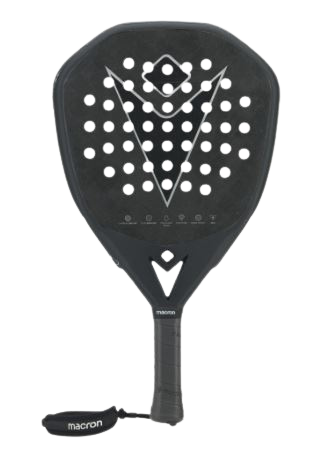
The Macron Hero Pro Power II 2026 is a diamond-shaped advanced racket built on an EVA 42 ultra-stiff foam core with a 24K carbon frame and playing surface oriented at 45 degrees with a sandblasted matte finish. Declared weight runs 360–370g, with a high balance point at 268mm. The standout proprietary system is Anti-Vibration Technology developed with RheonLabs, using non-Newtonian polymeric materials validated by the University of Bologna’s Sport Technology Lab DICAM — claimed to reduce peak wrist vibration by 23% and accelerate dampening by 30%. The Hero Pro Power II is the top-of-range power option in Macron’s 2026 lineup, updated from the 2025 collection alongside five other advanced models.
Spin at 6.2 is the lowest parameter in this profile — an unusual floor for a racket claiming precision. The gap between the attacker and defender profiles tells you exactly who this racket is for — and exactly who it will frustrate.
Performance Breakdown
How the Macron Hero Pro Power II 2026 Plays
STABILITY 8.1
The High-Balance Engine Does Its Job
A diamond shape with a 268mm balance point and an EVA 42 ultra-stiff core is a known formula — it channels energy efficiently into the ball on powerful, well-timed strikes. Power scores 8.3 and Stability scores 8.1, and neither is a surprise given the construction. What does stand out is how closely matched these two scores are: stability at this level usually requires some trade-off in raw power, but the 24K carbon frame construction appears to maintain structural rigidity without the typical flex-induced energy bleed. For a player who executes aggressive shots from the back of the court, these numbers represent a genuine performance ceiling.
PLAYABILITY 6.5
Weight and Balance Demand a Technical Foundation
At the upper end of the declared weight range — up to 370g — combined with a high balance point, this racket does not move quickly through the air. Maneuverability scores 6.5, which reflects a racket that rewards preparation and punishes late reactions. Playability matches that score exactly: 6.5 signals a tool that is competent in skilled hands but not forgiving for players still building consistency. This is where the attacker profile separates from the hybrid — at net exchanges and fast-reaction defensive blocks, the high balance point works against you, not with you.
COMFORT 6.3
SWEETSPOT SIZE 6.8
The RheonLabs System Softens the Blow — But Only So Much
An ultra-stiff EVA 42 core on a diamond shape produces a hard feedback loop — the Anti-Vibration Technology from RheonLabs is doing meaningful work here, and Comfort at 6.3 likely reflects a racket that would score notably lower without it. Control at 6.4 is the expected consequence of prioritizing stiffness: the ball leaves the face quickly and precisely only when contact is centered. Sweetspot Size at 6.8 is the relative bright spot — wider than you might expect from a high-balance diamond, suggesting the frame geometry distributes the effective hitting zone better than the core hardness alone would imply. Off-center contact, however, will transmit directly to the arm.
The One Number That Challenges the “Precision” Claim
Spin at 6.2 is the lowest individual score in this profile, and it deserves attention. The sandblasted matte finish on a diamond-shaped racket should theoretically support spin generation — rough surface, high swing speed potential. The gap between that expectation and the 6.2 score points to the limits of a very stiff frame: when dwell time is minimal and the ball exits the face fast, the surface texture has less time to work. Players whose attacking game depends on heavy topspin to keep powerful shots in the court will feel this ceiling. Flat, aggressive striking is where the Hero Pro Power II is calibrated.
Technology
RheonLabs Anti-Vibration Technology: Does University-Tested Mean On-Court Relevant?
The Anti-Vibration system uses non-Newtonian polymeric materials integrated into the frame — materials that behave rigidly under impact but dissipate vibration energy differently from conventional dampening foam. The University of Bologna’s Sport Technology Lab DICAM validated a 23% reduction in peak vibration transmitted to the wrist and a 30% improvement in dampening speed. These are specific, lab-derived figures — not marketing approximations.
The on-court implication connects directly to Comfort at 6.3. An EVA 42 ultra-stiff core without vibration management on this type of construction would typically score lower — the RheonLabs system appears to be holding that score up. What it cannot do is change the fundamental character of the hitting response: the racket is still stiff, still fast off the face, still demanding on off-center contact. The technology narrows the arm fatigue risk window, particularly over long sessions, but it does not convert the Hero Pro Power II into a comfort-oriented tool.
The 24K carbon at 45 degrees governs both Power (8.3) and Stability (8.1) — the angular orientation increases torsional rigidity, which reduces frame twist on off-axis strikes and keeps energy transfer efficient. This is the architecture that makes flat, powerful hitting consistent. Advanced players who generate power through technique rather than relying on frame assistance will feel the 24K construction as a genuine amplifier. Players who need the frame to do work on imperfect swings will find it unforgiving.
Player Fit
Who Should Buy the Macron Hero Pro Power II 2026?
The Advanced Attacker Who Hits Flat and Hits Hard
If you’re the type who plays primarily from the back of the court, generates power through swing technique rather than frame flex, and wins points with aggressive flat drives rather than heavy spin, this racket was built for your game. The attacker profile — driven by Power 8.3 and Stability 8.1 — reflects a construction that rewards decisive, well-prepared striking. You need to be physically comfortable with a 365–370g high-balance racket: the Maneuverability score of 6.5 is honest about the cost. If your technique is already solid and you’ve outgrown rackets that help you too much, the Macron Hero Pro Power II 2026 is a serious tool for your level.
Spin-Dependent Players and Anyone Below Advanced Level
If your attacking game relies on topspin to keep pace in the court, Spin at 6.2 is the number that ends this conversation. The ultra-stiff core minimizes dwell time to a point where the sandblasted surface can’t consistently do its job. The defender profile — the lowest of the three by a significant margin — also rules this out for any player who spends time at the net or needs to redirect fast-incoming balls quickly. And if you’re still developing technical consistency, Control at 6.4 and Comfort at 6.3 will punish you on every imperfect contact. If your game is built around control and placement rather than flat power, the Macron Hero Pro Control II 2026 is the same-tier alternative built for the opposite game.
FAQ
Frequently Asked Questions
What is the PadelVerdict score for the Macron Hero Pro Power II 2026?
The overall PadelVerdict score is 7.9, with a Consensus Modifier of 0 — specs are consistent across multiple sources (Data Quality: neutral), declared figures show no implausible outliers (Field Validation: neutral), but no independent measurements exist to confirm them (Market Correction: neutral). Consistent data without independent validation earns neutral, not positive. Profile breakdown: Attacker 7.93 / Hybrid 7.12 / Defender 6.55. The gap between the attacker and defender profiles is the clearest signal in the data — buy this as an attacking specialist or don’t buy it at all.
Is the Macron Hero Pro Power II 2026 good for advanced players?
Yes — but only for advanced players with an established attacking technique. Playability at 6.5 and Control at 6.4 make the answer conditional: this racket does not compensate for technical gaps. An advanced player who hits late, relies on spin, or plays an all-court game will find the Hero Pro Power II working against them more than with them. If you’re genuinely advanced and your game is built around flat, aggressive striking, it fits. Below that level, look elsewhere.
Is the Macron Hero Pro Power II 2026 good for attacking players?
Yes — it’s one of the cleaner attacker profiles in the current market. Power 8.3 and Stability 8.1 are the two pillars, and they hold up the attacker profile convincingly. The caveat is that “attacking player” here means a flat-hitting back-court aggressor, not a spin-heavy power player. If that description fits your game, explore the best attacker rackets — the Hero Pro Power II belongs in that conversation.
What is the actual weight of the Macron Hero Pro Power II 2026?
Declared range is 360–370g across multiple sources, with a nominal figure of 365g. No independent on-camera or lab measurement exists to confirm the actual weight of a production unit. A 10g declared range is already wider than typical for a pro-level racket — at the upper end of 370g combined with a high balance point, you will feel the difference on court compared to a 360g spec. Factor that into your decision, particularly if you’re coming from a lighter frame.
How does the Macron Hero Pro Power II 2026 compare to the Hero Pro Control II 2026?
These are two versions of the same construction philosophy aimed at opposite player priorities. The Power II is for the player who wants to dominate with explosive hitting and can live with Control at 6.4 and Spin at 6.2. The Hero Pro Control II is Macron’s answer for the player who needs more precision, more feel, and a softer feedback loop. The choice is straightforward: if your game is built on power and you trust your technique, take the Power II. If you’re looking for more touch and consistency, the Control II is the better fit.
Why does the Macron Hero Pro Power II 2026 have a Consensus Modifier of 0?
The technical specs — shape, core material, surface construction, balance classification, and weight range — appear consistently across all available sources. There are no contradictions to resolve. But consistent data and validated data are not the same thing. Everything available traces back to manufacturer descriptions and retailer listings. No independent physical measurements, no third-party lab testing, and no specialist reviewer analysis exist for this specific model. Consistent data without independent validation earns neutral, not positive. That is the honest position for a racket at this stage of its market life.