
Hyper Pro HRD 2026
Review
Joma Hyper Pro HRD 2026 Review: Is the Power Real or Just the Marketing?
Diamond-shaped attackers live and die by the same trade-off: the power ceiling climbs, but everything below it — control, comfort, forgiveness — gets squeezed. The question is never whether a high-balance diamond delivers force, but whether it delivers enough of the rest to stay useful across a full match. That’s exactly the decision the Joma Hyper Pro HRD 2026 forces you to make.
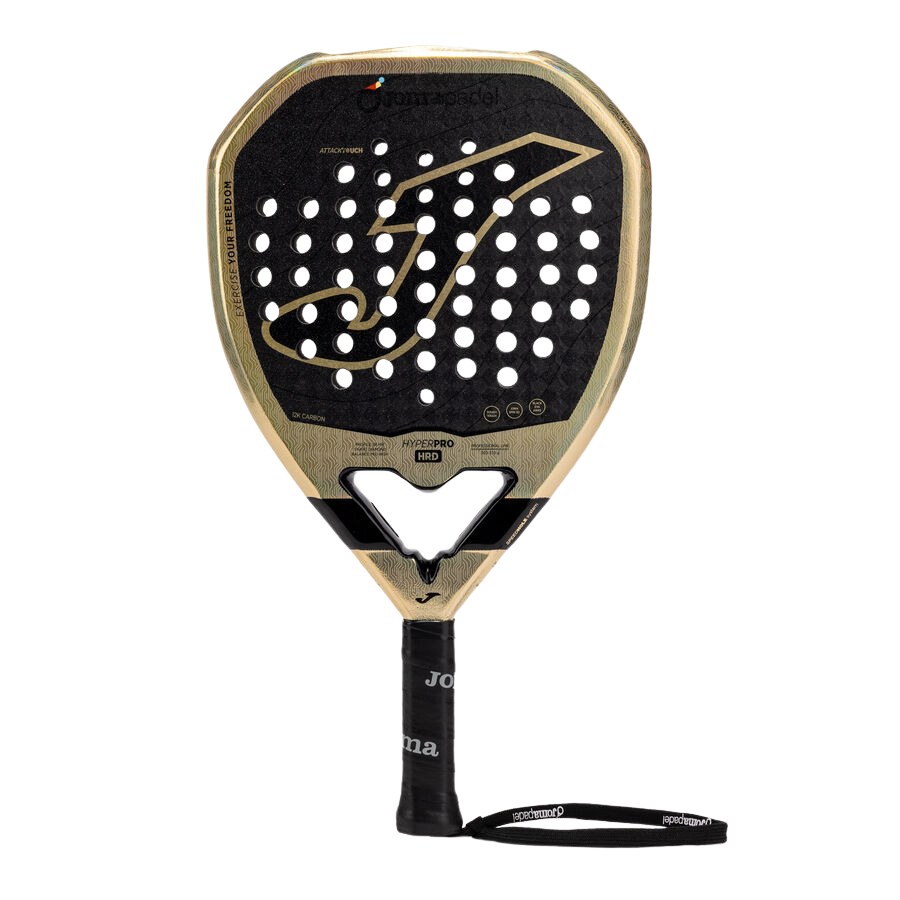
Built around a Black EVA HRD high-density foam core and wrapped in 12K carbon with a 3D Spin roughness texture, the Hyper Pro HRD sits at the aggressive end of Joma’s 2026 lineup. The DUALTECH FRAME reinforces the perimeter for power transfer and contact stability, while Aerobump Tech and the Speed Hole System are engineered to cut air resistance and sharpen swing speed. Frame profile hits 38mm. Declared weight is 368g at 261mm balance — both confirmed by an independent on-camera measurement.
Power leads at 8.3 — the highest single parameter in this racket. Attacker: 8.0 · Hybrid: 7.55 · Defender: 7.18. The 0.82-point gap between Attacker and Defender profiles is the clearest signal this racket sends: it was designed with one direction in mind, and that direction is forward.
Performance Breakdown
How the Hyper Pro HRD 2026 Plays
STABILITY 8.1
The High-Balance Dividend Pays Out
At 261mm balance and diamond geometry, the physics here are straightforward — but the execution matters. The DUALTECH FRAME in 12K carbon stiffens the perimeter without introducing the dead feel that plagues lower-grade frames, which is why Stability lands at 8.1 alongside Power’s 8.3. What surprises is how composed the racket remains on heavy smashes: contact doesn’t feel chaotic, it feels channeled. Players who commit to overhead finishes and flat drives will feel exactly the return the design promises.
SWEETSPOT 7.0
Spin Is the Secondary Weapon, Not a Footnote
The 3D Spin roughness texture on the carbon face does something more than marketing suggests — Spin at 7.6 is genuinely above average for a diamond attacker, where most of the energy typically goes into raw pace. The trade-off shows up in Sweetspot Size at 7.0: the contact zone sits high on the face, which rewards precise positioning but punishes off-center hits measurably. For attacking players who generate topspin on their drive volleys and finishing shots, that 7.6 is a genuine tactical tool. For anyone still developing positioning, the 7.0 sweetspot deserves respect.
COMFORT 6.8
The Numbers That Define the Ceiling
Control at 7.4 is respectable for a dedicated power diamond — it means the racket isn’t reckless, but it does require the player to impose structure on the shot. Comfort at 6.8 is the parameter that separates candidates from bystanders: the HRD core is specifically the harder of two available configurations, and at 368g with a high balance point, fatigue-related vibration becomes a real variable in long match play. Neither score is a disqualifier, but together they set an honest bar — this racket rewards technical confidence, not physical endurance alone.
PLAYABILITY 7.1
Aerodynamics Compensate — Partially
Maneuverability at 7.2 for a 368g high-balance diamond is genuinely better than the raw specs would predict — that’s the Aerobump Tech and Speed Hole System doing measurable work, not just design language. It won’t feel nimble compared to a round or drop-shaped diamond racket at lower balance, but for its category it moves. Playability at 7.1 reflects the combined weight of the lower comfort and tighter sweetspot — the racket asks something of you on every shot, which is the honest cost of accessing the 8.3 power ceiling.
Technology
DUALTECH FRAME + Aerobump Tech: Engineering or Branding?
The DUALTECH FRAME is the structural backbone: a 12K carbon perimeter construction that stiffens the outer frame without adding excess weight to the face. In practice, this is what separates the Hyper Pro HRD’s Stability score of 8.1 from cheaper diamond frames that feel rigid everywhere but deliver inconsistent contact — the stiffness here is targeted, not uniform. When you connect cleanly, the energy transfer is direct and immediate, which is exactly what the Power score of 8.3 reflects.
Aerobump Tech and the Speed Hole System address a real problem for high-balance diamonds: the leverage physics that generate power at the top also create drag on the swing. The aerodynamic channels through the frame reduce that resistance enough to keep Maneuverability at 7.2 — not extraordinary, but above the category floor. For players with fast, committed swing mechanics, the racket gets out of the way more than it resists.
The 3D Spin roughness texture on the 12K carbon face is the technology most likely to surprise. Applied as a three-dimensional surface relief rather than a simple abrasive coating, it creates friction angles that allow the ball to climb the face on topspin drives — which is why Spin sits at 7.6 despite the racket being fundamentally an attacker. It won’t transform a flat hitter into a spin artist, but for players who already generate topspin naturally, it amplifies the result. The beneficiary is the experienced offensive player who wants both power and shape on finishing shots — not the beginner hoping the texture does the work independently.
Player Fit
Who Should Buy the Joma Hyper Pro HRD 2026?
The Committed Net Player Who Closes Points
If you’re the type who lives at the net, structures your game around taking pace away and converting with force, and has already built the technique to consistently find the sweetspot — this racket was designed for your game. The Attacker score of 8.0, backed by Power 8.3 and Stability 8.1, validates a player who demands maximum output from overhead finishes and flat drive volleys. You’re comfortable with a 6.8 Comfort score because you understand that HRD means hard, and your arm has adapted. You don’t need the racket to be forgiving — you need it to be honest. This one is.
Developing Players and Arm-Sensitive Intermediates
If you’re still building consistency or feeling anything in your elbow after hard sessions, the Defender score of 7.18 tells the full story — this racket doesn’t give, it takes. The 6.8 Comfort combined with 368g at 261mm balance creates a vibration load that accumulates over time, and a Sweetspot of 7.0 means off-center contact is punished, not forgiven. The manufacturer rates this for advanced players for exactly this reason. If you want attacking power with more margin for error, the Joma Hyper Pro SFT is the more sensible starting point.
FAQ
Frequently Asked Questions
What is the PadelVerdict score for the Joma Hyper Pro HRD 2026?
The overall Verdict Score is 8.1, with a Consensus Modifier of +0.1 applied. Specs are consistent across multiple sources (Data Quality: neutral), specialist sources across multiple markets align on shape, core, surface, and the 368g/261mm balance figures with no contradictions found (Field Validation: positive), but no additional independent physical lab measurements exist to go further (Market Correction: neutral). That Field Validation component earns the +0.1. Profile breakdown: Attacker 8.0 · Hybrid 7.55 · Defender 7.18. The 0.82-point gap between top and bottom profiles is the clearest editorial signal in this review — if you’re not an attacker, that gap is working against you.
Is the Joma Hyper Pro HRD 2026 good for intermediate players?
Probably not yet. The 6.8 Comfort score is the decisive parameter here — at 368g with a high balance point and a hard EVA core, this racket places real physical demands on the player. Intermediates still developing consistent sweetspot contact will feel every off-center hit. If you’re at intermediate level with clear attacking ambitions, the SFT version of the same racket shares the diamond geometry with a softer core and is the more appropriate entry point.
Is the Joma Hyper Pro HRD 2026 good for attacking players?
Yes — unambiguously. Power 8.3, Stability 8.1, and an Attacker profile score of 8.0 confirm what the specs suggest. For net-oriented players who structure their game around finishing shots and overhead aggression, the score profile aligns precisely. If you already play an attacking style and want data to back the instinct, browse the best attacker rackets for direct comparison.
What is the actual weight of the Joma Hyper Pro HRD 2026?
Declared weight is 368g with a 261mm balance point, and an independent on-camera measurement confirmed both figures with no meaningful variance. That confirmation is part of what drives the +0.1 Consensus Modifier. At 368g with a high balance, the swing weight is perceptible — not heavy in the hand, but demanding through the arc. Players sensitive to swing weight should factor this in.
How does the Joma Hyper Pro HRD 2026 compare to the Hyper Pro SFT?
This is a choice between maximum output and managed risk. The HRD and SFT share the same diamond geometry and offensive intent, but the core changes everything. The HRD’s high-density EVA delivers the 8.3 Power ceiling and asks for precision in return — Comfort at 6.8 reflects that. The SFT’s softer core reduces vibration and forgives off-center contact, making it the better option for players building towards the attacking profile rather than operating fully within it. Same frame, different contract.
Why does the Joma Hyper Pro HRD 2026 have a Consensus Modifier of +0.1?
The +0.1 comes from a specific type of validation that goes beyond data consistency alone. Consistent specs across multiple sources earns neutral — that’s the baseline, and it describes most rackets we score. What moves the modifier here is that an independent on-camera measurement confirmed the declared 368g weight and 261mm balance point, and specialist-level sources across multiple markets aligned on shape, core, and surface characteristics with zero contradictions. That convergence — confirmed specs meeting independent measurement — is what earns the positive adjustment. A lab-grade RA stiffness measurement would be required to push further.