
FX Pro 2026

Review
Dunlop FX Pro 2026 Review: Is Raw Power Still the Right Bet at Advanced Level?
The tension in high-end padel racket design right now is simple: power rackets keep getting more powerful, but the players buying them are increasingly asking whether that extra punch comes at the cost of feel and range. The Dunlop FX Pro 2026 answers that question squarely from the attacker’s corner — it does not hedge. Diamond shape, high balance, hard Pro EVA core, and a stiffness rating of 72 make the design intent unmistakable before you ever hit a ball.
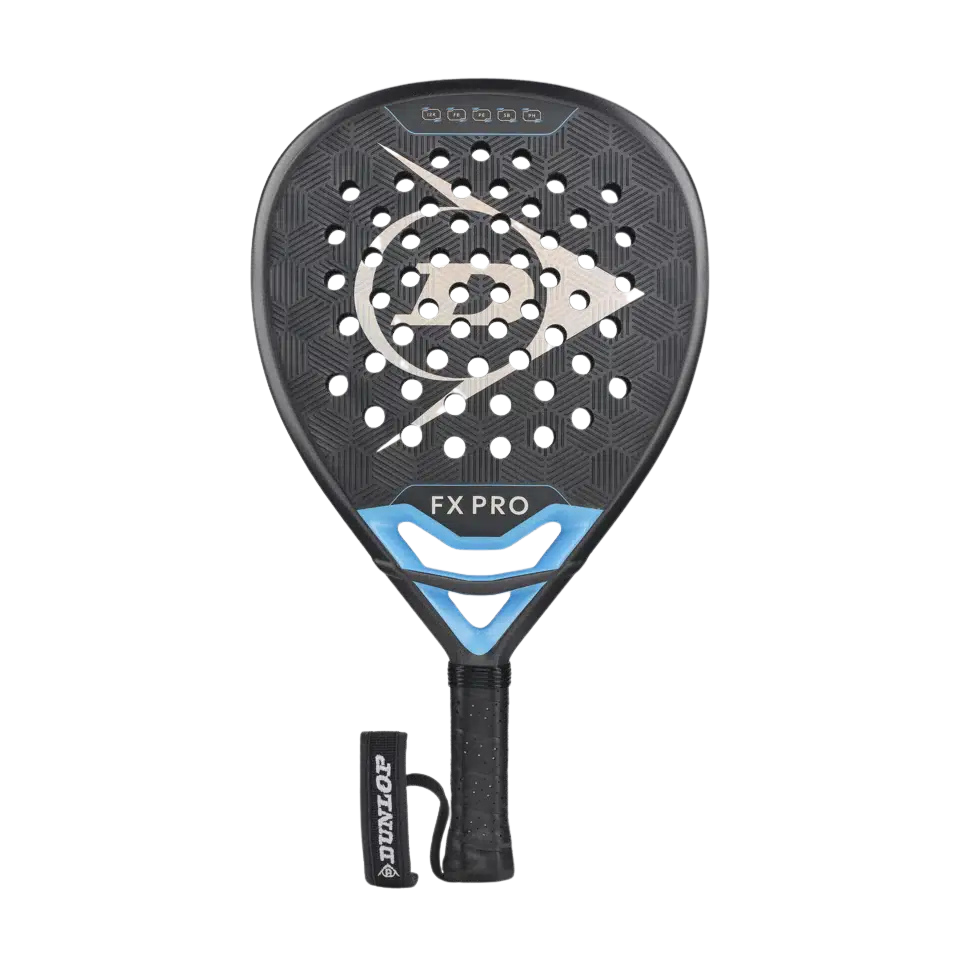
The FX Pro 2026 sits at the top of Dunlop’s FX line, declared at 370g with a high balance point of 268mm and a 38mm beam profile built from 12K carbon special weave throughout. The core is Pro EVA at hard density — reactive and firm, not forgiving. Proprietary systems include Force Bridge for torsional reinforcement, SpinBoost surface texturing for ball grip, Power Holes for an expanded power arc, Sonic Core Infinergy (a BASF-developed super-elastic insert) for rebound and vibration damping, and VibroShield as an additional anti-vibration layer in the frame. It is positioned firmly as a competition-level weapon for advanced and expert players.
Stability at 8.3 is the number that defines this racket’s identity — not Power at 8.4. Attacker: 8.11 · Hybrid: 7.63 · Defender: 7.26. The 0.85-point gap between Attacker and Defender is the widest spread in this range, and it tells the whole story: this is a specialist tool, not a versatile one.
Performance Breakdown
How the Dunlop FX Pro 2026 Plays
STABILITY 8.3
Two Numbers That Move Together
Diamond shape with a high balance point concentrates mass exactly where energy transfer happens, and the 12K carbon frame with Force Bridge reinforcement ensures that energy doesn’t bleed away in torsion under hard contact. Power lands at 8.4 and Stability at 8.3 — the tightest pairing in this racket’s profile, and deliberately so. The V-Energy Channel stiffens the frame edge, while the Power Holes redistribute the hitting area’s response for extra pace on smashes and volleys. At stiffness 72, there is very little energy absorption at impact — which is the point.
CONTROL 7.6
Spin Earns Its Keep; Control Has Conditions
Spin at 7.8 is a legitimate strength, and the SpinBoost surface texture is what makes it real — the raised 3D finish grips the ball at contact rather than relying purely on wrist speed. Control at 7.6 is respectable in isolation, but context matters: on a racket this stiff and this high-balance, control is primarily available to players with clean, high-contact technique. Mis-hits on a hard Pro EVA core at RA 72 don’t forgive. The control score reflects the racket at its best, not on tired shots or off-centre contact — that caveat is structural, not situational.
SWEETSPOT SIZE 7.0
More Arm-Friendly Than You’d Expect — Within Limits
A stiff diamond at 370g sounds like a recipe for arm stress, but Comfort at 7.2 lands higher than the frame profile alone would suggest. Sonic Core Infinergy absorbs a meaningful portion of impact shock — the BASF insert is not marketing gloss — and VibroShield adds a second damping layer that takes edge off hard-court vibration. Sweetspot Size at 7.0 reflects the honest trade-off of a high-balance diamond: the responsive zone is precise, not wide. Players who find that zone consistently will love it; those who miss it regularly will feel every miss. The Sweetspot score is the quiet warning sign in this racket’s data.
PLAYABILITY 7.1
The Price of High Balance — Paid in Full
Maneuverability at 6.8 is the lowest score on the sheet, and it is the direct mechanical consequence of the high balance point at 268mm combined with a 370g frame — there is significant rotational inertia to overcome. This is not a racket you flick into position; you bring it. Playability at 7.1 acknowledges that the FX Pro 2026 is functional across shot types for advanced players, but the Maneuverability score connects directly to the 0.85-point drop from Attacker to Defender profile — and it explains why the Defender score sits at 7.26. In baseline defence and rapid transitions, that 6.8 is load-bearing.
Technology
Five Systems, One Direction: Does the Dunlop FX Pro 2026 Technology Stack Actually Earn Its Complexity?
Five named systems is a long list, and the legitimate question is whether they reinforce each other or simply fill the marketing sheet. In the FX Pro 2026’s case, the stack has internal coherence — each element targets a specific physical problem that a stiff, high-balance diamond creates.
Force Bridge is a geometrical reinforcement built into the frame to resist torsional flex under off-axis contact. Its direct read-out is Stability at 8.3 — a score that reflects genuine resistance to frame twist, not just a stiff frame in isolation. Combined with the V-Energy Channel along the frame edge, the structural loop is complete: energy that enters the frame on hard contact is not lost in flex, it returns to the ball. That is where Power 8.4 comes from.
Sonic Core Infinergy is a BASF-developed super-elastic polymer insert — this is a material with a documented rebound and damping profile, not a brand name for standard EVA variants. On a racket with RA 72 and a hard Pro EVA core, something needs to absorb peak impact stress. Infinergy does it at the structural level, which is what lifts Comfort to 7.2 despite the stiffness rating. VibroShield adds a rubber anti-vibration layer specifically targeting high-frequency resonance after contact — the combination pushes Comfort above what the raw specs would predict.
SpinBoost is a textured surface treatment — raised, 3D finish — that increases ball-to-surface friction at the moment of contact. Spin at 7.8 is the direct result. This matters specifically for attacking players because topspin on smashes and penetrating drives adds a dimension beyond raw pace. The diamond shape concentrates the hitting zone where SpinBoost is most active, making the combination genuinely effective for players who attack with spin rather than just flat power.
Power Holes are a proprietary hole distribution pattern designed to expand the effective hitting area and increase pace. Their contribution is modest but measurable — they sit behind the headline Power score alongside the balance point and carbon construction rather than driving it alone. Who benefits from all five systems working together: the advanced attacking player with consistent, well-timed technique who wants maximum energy transfer on offensive shots, minimal arm stress for a racket of this stiffness, and spin as a genuine tactical weapon.
Player Fit
Who Should Buy the Dunlop FX Pro 2026?
The Advanced Attacker Who Doesn’t Miss the Same Spot Twice
If you’re the type who plays the net aggressively, arrives to smashes in position, and has already spent years developing clean contact mechanics — this racket was designed around your game. Power at 8.4 and Stability at 8.3 reward high-pace offensive play, while Spin at 7.8 via SpinBoost adds tactical depth to your attacking arsenal. The Sweetspot at 7.0 means you need to earn those scores through consistency, not compensation. If your technique is already reliable, the FX Pro 2026 doesn’t ask you to hold back — it asks you to commit. That’s exactly the deal advanced attackers want.
Players Who Still Need the Racket to Cover Their Mistakes
The Defender score of 7.26 is the lowest profile rating here, and Maneuverability at 6.8 is the parameter that drives it. If you rely on retrieval, rapid repositioning, or defensive transitions to stay in rallies — this racket will work against you in those moments. The same is true if your technique is still being built: a Sweetspot of 7.0 on a stiff RA 72 diamond at 370g is unambiguous on mis-hits. The FX Pro 2026 is not a developmental tool. If an all-court, hybrid game is closer to your reality, the FX Lite at 355g with a medium balance point is the more honest option from the same range.
FAQ
Frequently Asked Questions
What is the PadelVerdict score for the Dunlop FX Pro 2026?
The overall Verdict Score is 8.1, with a Consensus Modifier of 0 — specs are consistent across multiple sources (Data Quality: neutral), declared figures show no implausible outliers (Field Validation: neutral), but no independent physical measurements exist to confirm them (Market Correction: neutral). Consistent data without independent validation earns neutral, not positive. Profile breakdown: Attacker 8.11, Hybrid 7.63, Defender 7.26. That 0.85-point gap between top and bottom tells you immediately: this is a specialist racket, not a generalist one.
Is the Dunlop FX Pro 2026 good for advanced players?
Yes — but only for advanced attackers with clean, consistent technique. The Sweetspot at 7.0 and stiffness at RA 72 make the racket demanding rather than forgiving. If you’re an advanced player who plays a hybrid or all-court game, Power at 8.4 will feel like overkill in rallies where feel and retrieval matter more than pace. In that case, look at medium-balance options from the same performance tier.
Is the Dunlop FX Pro 2026 good for attacking players?
Yes, without qualification. The Attacker profile score of 8.11 is supported by Power 8.4, Stability 8.3, and Spin 7.8 — a combination that covers the three fundamentals of offensive padel: pace, structural consistency under hard contact, and ball bite for penetrating topspin shots. If attacking is your primary identity on court, this racket is built for you. See all best attacker rackets to compare options at this level.
What is the actual weight of the Dunlop FX Pro 2026?
Declared at 370g with a manufacturer tolerance of ±10g — meaning any unit between 360g and 380g is within spec. No independent on-camera measurements exist to confirm real-world variance. At 370g with a high balance point of 268mm, the swing weight is noticeably higher than the raw gram figure suggests. That difference is perceptible on court, particularly on rapid exchanges and defensive transitions.
How does the Dunlop FX Pro 2026 compare to the FX Lite 2026?
This is a choice between two player types, not two weight categories. The FX Pro is for the player who prioritises offensive punch and stability over agility — high balance, hard core, 370g. The FX Lite drops to 355g with a medium balance point, trading some raw power for significantly better Maneuverability. If you’re deciding between the two, the honest question is: do you attack from set positions, or do you need to move the racket quickly into space? The answer determines the racket.
Why does the Dunlop FX Pro 2026 have a Consensus Modifier of 0?
The specifications appear consistently across multiple markets, and nothing in the declared data looks implausible for a racket of this construction. That earns a neutral baseline — not a positive one. What would move the modifier upward is independent physical validation: on-camera measurements confirming declared weight and balance, or cross-market specialist convergence beyond retailer descriptions. Neither exists for this model. Consistent manufacturer data without independent confirmation earns neutral. That is the correct result, not a provisional one.