
Canyon Pro Attack 2.0 2026
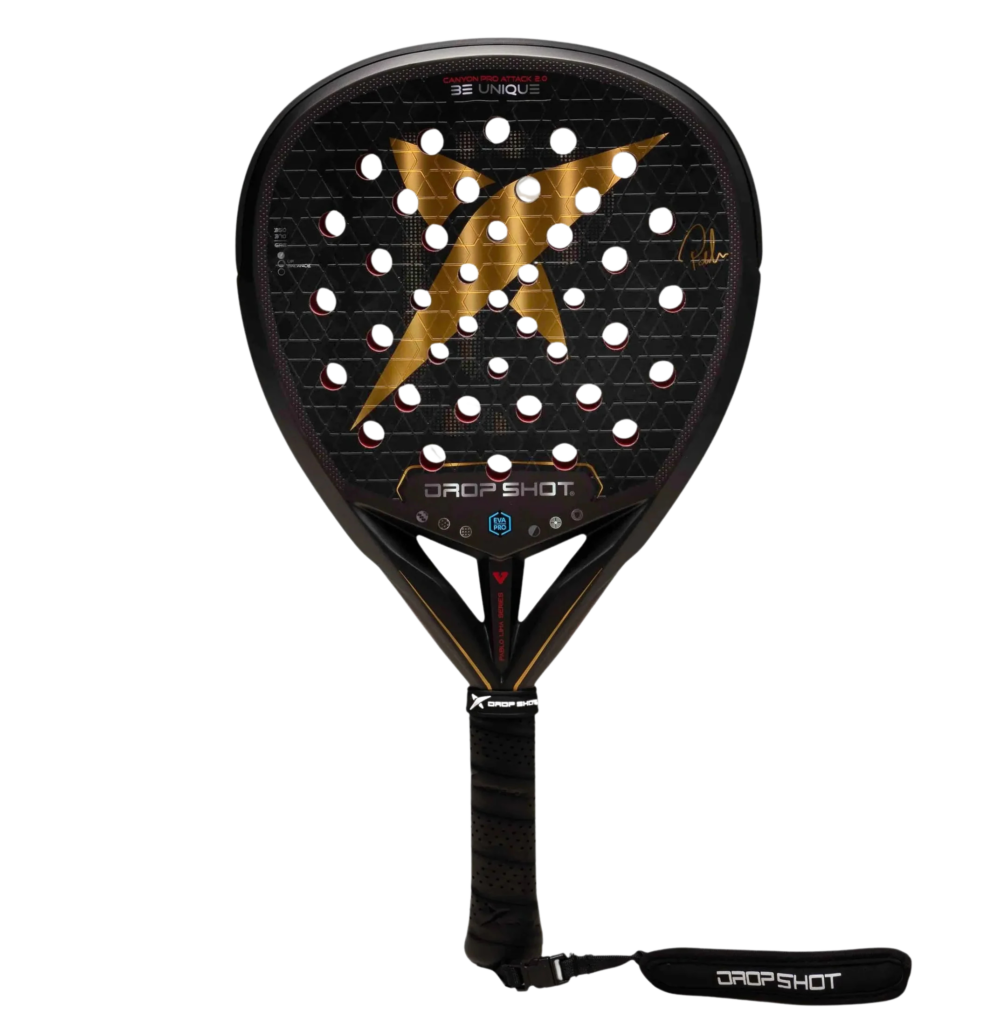

Review
Drop Shot Canyon Pro Attack 2.0 2026 Review — Is the Power Worth the Trade-Off?
Diamond rackets make a contract with the player: maximum offensive output in exchange for working harder everywhere else. The Drop Shot Canyon Pro Attack 2.0 2026 takes that contract seriously — high balance, hard touch, dense core — and dares you to ask whether the control and comfort you’re giving up is a price worth paying for what you get at the net.
This is Pablo Lima’s signature model for 2026, built around an EVA Pro High Density foam core and a 24K Carbon Twill Textreme surface with a 3D rough texture for added spin. The frame runs a Twin Tubular Carbon construction, reinforced by the Power Beam Heart system at the racket’s core, and the Vibra Tech system handles vibration damping throughout. Balance sits at 268mm — firmly in the high range — and the 38mm thickness confirms this is built for power transfer, not forgiveness. It is an advanced-level diamond racket designed for players who already know what they’re doing.
Stability at 8.2 is the headline — this racket does not move in your hand. Attacker: 7.97 · Hybrid: 7.44 · Defender: 7.12. The 0.85 gap between the top and bottom profiles is the whole story: the Canyon Pro Attack 2.0 is an offensive specialist, and the defender gap makes that non-negotiable.
Performance Breakdown
How the Canyon Pro Attack 2.0 2026 Plays
STABILITY 8.2
The Net Is Where This Racket Was Built
The high balance point at 268mm concentrates mass toward the head, and the Twin Tubular Carbon frame transforms that geometry into explosive smash and volley output. Power at 8.3 is not a surprise given the setup — what earns attention is Stability at 8.2, which tells you energy stays in the ball rather than dissipating on off-center strikes. The Power Beam Heart reinforcement at the racket’s core is the mechanism behind that figure: it prevents the frame from flexing under impact, ensuring clean transfer even when technique isn’t perfect. For an attacking player, that combination is exactly the brief.
SWEETSPOT SIZE 7.1
Usable Precision — On the Condition You Swing Correctly
Control at 7.6 is the figure that separates the Canyon Pro Attack 2.0 from maximum-power-only tools. That number is real, but it’s conditional: the EVA Pro High Density core provides a firm, responsive feel that rewards clean contact, while the 3D rough Textreme surface contributes to ball placement through spin generation. Sweetspot Size at 7.1 is fair for the category — diamond shapes with high balance and stiff frames will never be forgiveness machines — but it means the window for clean control is genuinely usable without demanding tour-level precision on every shot. This is not a control racket, but it won’t punish you on every slight mishit either.
PLAYABILITY 7.0
Spin Is a Tool Here, Not a Selling Point
Spin at 7.2 on a diamond racket is not something to take for granted. The 3D rough texture on the Textreme surface actively grips the ball on contact, contributing to topspin on drives and kick on serves rather than leaving spin entirely dependent on swing mechanics. Playability at 7.0 reflects an honest accounting of the racket’s positioning: it is advanced-level hardware, and the stiff frame means the learning curve is real for anyone still building technique. That figure is not a weakness — it’s a warning label. The Canyon Pro Attack 2.0 rewards investment; it doesn’t subsidize inconsistency.
MANEUVERABILITY 6.8
Two Numbers That Tell You Exactly Who This Isn’t For
Comfort at 6.7 and Maneuverability at 6.8 are the lowest scores in the profile, and together they define the ceiling for who can use this racket effectively. The declared weight ranges up to 375g, the balance sits high, and the frame is stiff — that combination demands physical conditioning and technique. The Vibra Tech system does contribute meaningful vibration damping, preventing Comfort from dropping further, but players with arm or elbow sensitivity should treat the 6.7 with appropriate seriousness. Maneuverability at 6.8 reflects the head-heavy geometry: reset shots and quick exchanges at the net require technique to compensate for the extra mass in the head. These are not flaws — they are design consequences.
Technology
Power Beam Heart and Vibra Tech: Do Two Systems Justify the Stiffness?
The Power Beam Heart reinforces the geometric center of the frame — the zone where torsional flex typically bleeds energy on off-center contact. By stiffening that zone specifically, Drop Shot keeps the frame rigid through impact without having to make the entire racket harder to use. The direct output is Stability at 8.2: shots that aren’t perfectly centered still transfer the majority of their energy into the ball rather than losing it to frame flex. That is not a marketing claim — it is the mechanical explanation for why a racket this head-heavy can hold together under rapid, consecutive strikes at the net.
Vibra Tech sits on the opposite end of the physical experience. The system uses specific material layers and hole geometry to redirect vibration away from the handle rather than simply dampening it with grip mass. The result is Comfort at 6.7 — which in context of a stiff, high-balance diamond is a better outcome than the raw architecture would suggest. Without Vibra Tech, the 72 stiffness rating and dense EVA Pro core would combine to produce a harsher feel; the system pulls the number up from where it would otherwise land.
The Twin Tubular Carbon frame construction ties both systems together by providing consistent stiffness distribution across the entire frame perimeter. This is what enables the 24K Carbon Twill Textreme surface — a material that demands a stable, non-flexing backing to produce its spin-generating 3D texture reliably on contact. The Spin score of 7.2 on this type of racket is partly a surface story, but it’s the structural rigidity underneath that lets the surface do its job. The technology stack here is coherent — each element earns its place in the design. Players who benefit are those technical enough to exploit stability and power rather than needing forgiveness and comfort as a baseline.
Player Fit
Who Should Buy the Canyon Pro Attack 2.0 2026?
The Advanced Net Dominator Who Competes Regularly
If you’re the type who positions aggressively at the net, looks for the smash or the put-away volley on every high ball, and has the physical conditioning to wield something in the 360–375g range without fatigue, this racket was designed around your game. Power at 8.3 and Stability at 8.2 give you the offensive ceiling; Control at 7.6 means you’re not sacrificing placement for power. You’ve been playing for years, you compete regularly, and the idea of a racket that demands technique rather than subsidizing it feels like the right deal. The Canyon Pro Attack 2.0 2026 is the one that makes you feel like you’re the sharpest person on the court — and the data backs that up.
Developing Players and Anyone Still Building Their Technique
The Defender score of 7.12 — the lowest in the profile and nearly a full point below the Attacker score — tells you plainly that this racket resists anything that isn’t offensive. Maneuverability at 6.8 means quick resets and defensive exchanges require more work than average, and Comfort at 6.7 makes it a liability for players with arm or elbow sensitivity. If you’re still developing consistency, the stiff frame will punish mishits rather than forgive them. If your game is built from the baseline, look at the Canyon Pro Comfort 2.0 2026 or the hybrid racket category instead — this diamond is not your tool.
FAQ
Frequently Asked Questions
What is the PadelVerdict score for the Drop Shot Canyon Pro Attack 2.0 2026?
The PadelVerdict score is 8, with a Consensus Modifier of 0. Specs appear consistently across multiple sources (Data Quality: neutral), declared figures show no implausible outliers (Field Validation: neutral), but no independent physical measurements exist to confirm them (Market Correction: neutral). Consistent data without independent validation earns neutral, not positive. Profile breakdown: Attacker 7.97 · Hybrid 7.44 · Defender 7.12. That 0.85 gap between Attacker and Defender is the decisive number — this is a specialist tool, not a versatile one.
Is the Drop Shot Canyon Pro Attack 2.0 2026 good for advanced players?
Yes — specifically for advanced players with an offensive game. Playability at 7.0 reflects the technical requirement: this racket rewards players who already have clean mechanics and physical conditioning to handle up to 375g with a high balance. If you’re at an intermediate level still building consistency, the stiff frame and low Maneuverability score (6.8) will work against you more often than for you. The Canyon Pro Attack Soft 2026 is worth considering if you want the same lineup but more forgiveness.
Is the Drop Shot Canyon Pro Attack 2.0 2026 good for attacking players?
Yes. Attacker score of 7.97 is the highest profile in the range, backed by Power 8.3, Stability 8.2, and a Control 7.6 that keeps placement viable alongside the offensive output. If your game is built around net aggression, smash dominance, and dictating points from the front, this is exactly the tool. Browse the best attacker rackets if you want to compare your options before deciding.
What is the actual weight of the Drop Shot Canyon Pro Attack 2.0 2026?
The declared weight is 365g, but manufacturer sources vary — some list a range of 350–370g, others 360–375g. No independent on-camera or laboratory measurements exist for this model. The upper end of that range (375g) is perceptible on court, especially over a full match, and is relevant for players managing arm fatigue. Until independent measurements are available, treat the declared 365g as a midpoint estimate rather than a confirmed figure.
How does the Drop Shot Canyon Pro Attack 2.0 2026 compare to the Axion Attack 2.0 2026?
The Axion Attack 2.0 is the more aggressive option — designed for maximum power output with less emphasis on control integration. The Canyon Pro Attack 2.0 is the choice if you want Power 8.3 alongside Control 7.6 and Stability 8.2 — power with a usable precision layer. If your priority is pure offensive firepower above all else, the Axion is your racket. If you want to be dangerous without sacrificing placement entirely, the Canyon Pro Attack 2.0 2026 is the smarter choice.
Why does the Drop Shot Canyon Pro Attack 2.0 2026 have a Consensus Modifier of 0?
The specs for this racket are consistent wherever you look — shape, core, surface, balance, and weight all align across multiple sources without contradictions. That consistency is the baseline; it earns neutral, not positive. What’s missing is the layer above consistency: independent physical measurements confirming declared figures, or specialist-level field convergence across multiple markets going beyond retailer descriptions. No community feedback, no on-camera weighings, no lab data exist for this exact model. Consistent data without independent validation earns a 0, not a positive modifier. Independent measurements would be what changes that.