
Piton White 2026
The Control Bet That Holds
The short verdict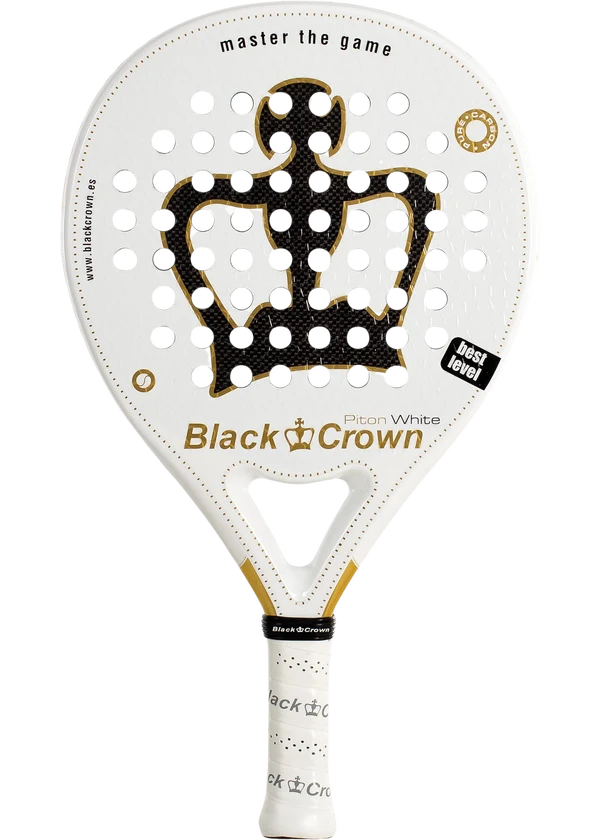


8 Parameters
Piton White 2026
On this page
Review
Black Crown Piton White 2025 Review — The Control Bet That Holds
There is a persistent tension in padel between making a racket that beginners can use and one that advanced players won’t outgrow. Most manufacturers resolve it by leaning one way and hoping nobody notices. The Black Crown Piton White 2025 makes a different call: it leans hard into control and sweetspot generosity, accepts a deliberate ceiling on power, and bets that the right player won’t miss what it trades away. That is a coherent position. Whether it is the right one depends entirely on who is holding it.
Structurally, the Piton White 2025 is a round-shaped racket built around a Medium White EVA foam core with a stiffness rating of 45 — medium territory, neither plush nor demanding. The surface is 3K carbon aluminium with a 5D ExtraSpin rough texture, which adds grip to the ball through slices, bandeja, and topspin exchanges. The frame incorporates Black Crown’s Low Density Piton Glass technology, which modulates flex and dampens vibration across the hitting zone. Declared weight sits at 363g with a 260mm balance point, keeping the feel predictably low in the hand. This is part of the broader Black Crown lineup for 2025 — positioned as an intermediate-to-advanced all-court option, not a specialist weapon.
Sweetspot Size and Maneuverability both reach 8.4 — the two highest scores in the set. The gap between the Attacker and Defender profiles is 0.52 points — the whole story: this racket is built to return and construct, not to finish.
Performance Breakdown
How the Black Crown Piton White 2025 Plays
MANEUVERABILITY 8.4
The Foundation That Doesn’t Punish You
Round shapes don’t automatically guarantee large sweetspots — core density and balance point matter just as much. Here, the Medium White EVA paired with the 260mm balance creates a forgiving hitting window that rewards consistency rather than precision. Both Sweetspot Size and Maneuverability score 8.4, the joint-highest marks in this racket’s profile, and that is not a coincidence: the same low balance that makes it quick through the air also distributes contact across a wider zone. At the net, transitions between forehand volleys and overhead blocks happen without fighting the racket’s momentum.
COMFORT 8.1
Precision Without the Sting
Control at 8.3 reflects a core that gives enough feedback to place the ball without demanding elite swing mechanics to do so. The feel sits in a deliberate neutral zone — not the soft absorption that washes out touch, and not the rigidity that turns mis-hits into feedback spikes. Comfort at 8.1 is where the Low Density Piton Glass earns its name: vibration is dampened through the frame before it reaches the arm, which matters across extended defensive rallies where fatigue accumulates. No quality issues have been identified for this model, which aligns with the clean structural logic of its build.
SPIN 7.2
Reliable in Every Phase, Spin Is the Honest Limit
Playability at 8.4 is the score that validates the racket’s brief: this is a racket that functions well in every phase of a point, from defensive recovery to mid-court construction. The 5D ExtraSpin rough texture contributes on slices and topspin lobs, but Spin scoring at 7.2 tells the honest truth — the surface texture helps, but it doesn’t compensate for the round shape’s inherent limitation in generating angular ball flight. Players relying on heavy topspin drives or spin-loaded attackers from the back will find the ceiling. That constraint is the direct reason the Attacker profile sits 0.44 points below the Hybrid score.
STABILITY 7.4
Where the Trade-Off Becomes Visible
Power at 7.6 and Stability at 7.4 are the two lowest scores, and they tell the same story from different angles. A 260mm balance point and round shape sacrifice frame momentum — there is simply less mass behind the hitting zone at pace. Stability at 7.4 means that off-centre smashes or hard cross-court drives will produce more rotational feedback than a heavier diamond-shaped alternative. Neither score is a flaw for the player this racket targets; both become relevant the moment someone tries to use it as a finishing weapon. The Attacker score of 7.73 reflects exactly this ceiling rather than a structural weakness.
Technology
Low Density Piton Glass: Does Less Mass Actually Mean More Feel?
Low Density Piton Glass operates on a principle that runs counter to what most players assume about carbon construction. Rather than maximising rigidity, it introduces controlled flex into the frame — a lower-density glass fibre layer within the carbon structure that absorbs impact energy before it travels into the shaft. The practical effect is vibration reduction across the hitting zone, which connects directly to the Comfort score of 8.1. Players who have spent time with stiffer carbon rackets and experienced arm fatigue in long defensive exchanges will notice the difference here.
The system’s second function is feedback preservation. By dampening vibration without fully softening the core response, the frame still communicates contact quality to the hand — which is what keeps Control at 8.3 rather than drifting toward the vague, pillowy feel that fully foam-padded constructions can produce. The Medium White EVA core and Low Density Piton Glass work together: the core provides the touch, the glass layer protects the arm from the consequences of that touch at volume.
The 5D ExtraSpin rough surface texture sits on 3K carbon aluminium — a construction that prioritises surface contact over outright power transmission. In practical terms, it rewards compact wrist motion on slices and bandejas more than full accelerated drives. Among round-shaped rackets in this segment, this surface spec is one of the more aggressive rough finishes available, but it operates within the physical limits of a round frame. It adds spin texture without converting the racket into a spin-dominant weapon — which is exactly what the Spin score of 7.2 reflects.
Who benefits most: intermediate players who want to extend their hours on court without arm consequences, and experienced defenders who demand feel and forgiveness over finishing power. The technology is honest about what it offers and doesn’t pretend to solve the power equation it deliberately bypasses.
Player Fit
Who Should Buy the Black Crown Piton White 2025?
The Consistent Intermediate Who Builds Points
If you’re the type who wins points through positioning and patience rather than putting the ball through the back glass, this racket is aligned with how you already think about the game. A Sweetspot Size of 8.4 means off-centre contacts in defensive recovery don’t punish you, Maneuverability at 8.4 keeps you quick at the net, and Control at 8.3 means your placements are where you intend them to be under pressure. The Defender score of 8.25 confirms that this is where the racket is most at home. You’re the player who makes their partner look good — and this racket will make you look good right back.
The Attacking Player Who Wants to End Rallies
If your game centres on finishing from the back or loading smashes with pace and spin, the Piton White 2025 will frustrate you before the first set is over. Power at 7.6 and Stability at 7.4 — the two lowest scores in the profile — mean the racket loses authority exactly when you need it most: on hard contacts at the top of the swing. The Attacker score of 7.73 isn’t a gap; it’s a ceiling. A diamond-shaped racket with a higher balance point would serve your game better.
FAQ
Frequently Asked Questions
What is the PadelVerdict score for the Black Crown Piton White 2025?
The overall PadelVerdict score is 8.4, with a Consensus Modifier of 0 — specs are consistent across multiple sources (Data Quality: neutral), no independent physical measurements exist to confirm declared figures (Field Validation: neutral), and no additional cross-market validation exists to go further (Market Correction: neutral). Profile breakdown: Attacker 7.73 / Hybrid 8.17 / Defender 8.25. The 0.52-point gap between Attacker and Defender tells you exactly where this racket belongs — and where it doesn’t.
Is the Black Crown Piton White 2025 good for intermediate players?
Yes, directly. A Playability score of 8.4 and Sweetspot Size of 8.4 mean the racket doesn’t demand technical precision to function well — it works with you across all phases of a point. The medium-stiff core and low balance point make it manageable without being slow. If you’re an intermediate building toward consistent all-court play, this is a natural fit. If you’re already competing at a high level and looking to push attacking depth, you’ll want something with more frame mass behind it.
Is the Black Crown Piton White 2025 good for defenders?
Yes. The Defender score of 8.25 is the highest profile score this racket earns, and it’s supported by the right numbers: Control 8.3, Comfort 8.1, Sweetspot Size 8.4. You get feel, forgiveness, and arm protection in a package that moves quickly. If you’re looking at the full defender racket category, the Piton White 2025 belongs in that conversation — particularly for players who prioritise comfort over raw defensive stability.
What is the actual weight of the Black Crown Piton White 2025?
The declared weight is 363g, with a manufacturer range of 355–370g cited across multiple sources. No independent scale or physical measurements exist for this model, so the declared figure cannot be confirmed or contradicted by external data. A 363g racket at 260mm balance sits on the lower end of mid-weight — most players transitioning from lighter rackets will not notice a significant difference, but those moving from sub-355g options may feel a small increase in hand presence.
How does the Black Crown Piton White 2025 compare to the Piton White Soft 2025?
The choice is essentially about frame material and feel preference. The Piton White uses 3K carbon construction, which gives it more feedback and a firmer response — better suited to players who want to feel the ball. The Piton White Soft 2025 uses a fibreglass frame, which softens the feel further and increases forgiveness, but trades away some precision in exchange. If you value touch and control over pure absorption, the standard Piton White is the right call. If arm sensitivity is a concern or you prefer a very soft feel, the Soft variant is the alternative.
Why does the Black Crown Piton White 2025 have a Consensus Modifier of 0?
The specs for this racket appear with strong consistency across multiple markets — shape, core, surface texture, balance, and stiffness description all align without contradiction. That earns the baseline. What keeps the modifier at 0 rather than moving it to +0.1 is the absence of any independent physical validation: no scale measurements, no independent balance point confirmations, no physical data exists for this specific model year. Consistent data without independent validation earns neutral, not positive. Independent measurements would be the only path to a higher modifier.
Similar Rackets
Independent testing, funded by readers
No brand deals, no sponsored picks. If you found this useful, you can support the next round of tests with a small tip.

